When researching Allegany County history, the first resources I turn to are books by John S. Minard. Without his writings, much of the county’s storied history would be lost. Throughout his lifetime, he collected the stories, genealogies, and histories of Allegany County’s pioneers, the Seneca people, businesses, and events. His life story deserves to be remembered, just as he carefully documented the lives of Allegany County’s pioneers.
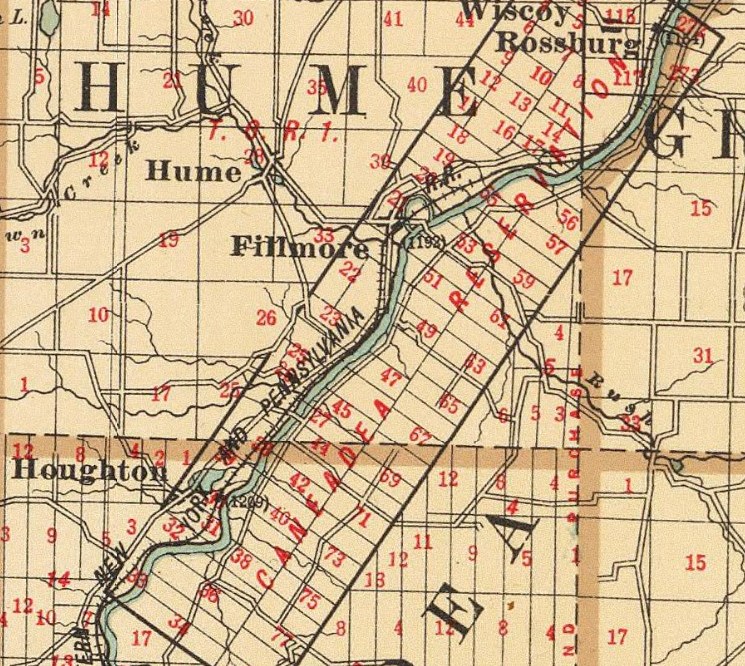
John Stearns Minard was born January 31, 1834, in the Town of Hume within the boundaries of the Caneadea Indian Reservation. His parents were George M. and Maria Burt Minard, and John was the eldest of four children. During the 1840s and 1850s, John attended a log schoolhouse on the Reservation in the Town of Hume, the Hume Union School; the Castile Scientific and Mathematical Institute, run by Professor Davis W. Smith; and the Genesee Wesleyan Seminary in Lima, New York.
In 1853, George Minard died, leaving John at age 19 to financially support his mother and younger siblings. He left school to run the family farm and also became a surveyor to supplement his income. In 1858, he married Mary A. Nye. John and Mary adopted two siblings, Edwin Forest and Julia Elizabeth, who had been orphaned around 1868. The couple was unable to have children of their own. The family stayed on the homestead until 1871, when John sold a portion of the farm and opened a general store with John M. Hammond and George Marvin. A picture of the store is in the 1879 History of Allegany County and is shown in the slideshow below. John also purchased a large acreage of timbered land in 1880, expecting to make a good profit, but he faced financial ruin a short time later. He even wrote about it, saying he experienced “large losses and pecuniary embarrassment.” In his attempt to recover his financial footing, he opened a store in the Old Mechanics Hall under the name of Wells and Minard in 1882, and later built a store that he operated for a few years. He had an impeccable reputation for integrity and fairness in all his business dealings, but he wasn’t a gifted businessman. He also served as the supervisor for the Town of Hume, its Justice of the Peace, and in 1873 was the town agent for railroad bonds. But it was through his surveying work for several townships, the expanding railroads, and private individuals, including William Pryor Letchworth, that he supported his family.
John had worked closely with Mr. Letchworth, and the two men developed a friendship, both sharing a deep interest in the Seneca people. It was John Minard who began talking with him about the Caneadea Council House, and the possibility that it was going to be razed. The Council House, which predates the Revolutionary War, was on the verge of collapse, but both men agreed that it must be saved for future generations. (More on the history of the Caneadea Council House)
In the fall of 1871, Mr. Letchworth purchased the Council House, and with the help of John and a Seneca man, arranged to have it dismantled and transported via the Genesee Valley Canal to what is now Letchworth State Park. The Council House was the meeting place of great chiefs, such as Cornplanter, Red Jacket, and Little Beard, and the location of many important decisions of the Iroquois Confederacy. It was rebuilt and repaired on what are now the Council Grounds at the park. Without John Minard’s and William P. Letchworth’s work, we wouldn’t be able to see this historic house today.
All the while that John worked to keep food on the table, he was also burning the midnight oil to write about the stories and histories he constantly gleaned from old-timers and other sources. He was passionate about preserving these important accounts from the early days of the county. He loved a good story, and also knew how to write one. In fact, the Allegany County Historical Society has some of his handwritten manuscripts, and you can see them here.
His first major work was as the primary contributor to the F. W. Beers, History of Allegany County, N.Y. 1806-1879. In 1888, he published Hume Pioneer Sketches: A History of Early Times, First Settlers, Pioneer Experiences and Hardships, Our Predecessors, the “Six Nations.” He went on to publish perhaps his most famous and profitable work, Life of Major Moses Van Campen in 1893, and in 1896, his massive tome, Allegany County and Its People: A Centennial Memorial History of Allegany County, New York, Illustrated. In 1905, he published Ye Olde Log School House Tymes, and several other local histories.
He was also a sought-after speaker during those years, giving addresses at multiple historic occasions, including Allegany County’s centennial in 1895 at Wellsville, and the centennial of the Treaty of Big Tree in 1897, held in Geneseo. He was a regular speaker at the Rochester and Buffalo Historical Societies, and one of his favorite topics was recounting the history of the Senecas. He wrote dozens of newspaper articles and organized the Allegany County Historical Society, which officially formed in 1889, as its first president. In September 1907, he was instrumental in having the Daughters of the American Revolution install a boulder with a plaque at the original site of the Caneadea Council House. The plaque also commemorates Major Moses Van Campen, which is on private property today.
However, during these busy years of working the day job, writing, and speaking, John and Mary suffered the loss of both their adopted children. Their son, Forest died in 1887 at age 27, and Julia died in 1897, age 36. Tragically, Julia married F. W. Hark not long before her death from consumption, and they had no children.
The Minards also experienced other difficulties, as the Bolivar Breeze reported in September 1896 that John (age 62) had fallen from his wagon and into the road, breaking his collarbone and dislocating his shoulder. Mary was still recovering from a broken ankle at the time. Their finances were generally precarious despite John’s efforts to sell his books, which he regularly advertised in the local papers.
A happy occasion occurred in October 1908, when John and Mary celebrated their 50th wedding anniversary at their home on Grove Street, Cuba. The neighborhood ladies organized a party for the couple, and many came to congratulate them.
On August 12, 1911, Mary Nye Minard passed away and was buried in Pine Grove Cemetery, Fillmore. She had previously suffered strokes and was 72 when she died. John remained in Cuba, but his financial situation worsened, along with his health, and then around 1913 he became completely blind. However, this didn’t stop him from writing, and he continued by dictating his manuscripts. Sadly, in September 1914, The Andover News reported that John was transported to the Allegany County Poorhouse for care. The elderly, blind man had taken with him a locked tin box that held $134 he’d managed to save for his care. When he handed the box over to Mr. Grunder, head of the county home, and the box was opened, it was found to be empty. “Uncle Dan,” the man who took him to the county home in Angelica, was accused of being a thief by the newspaper. Whether the money was ever recovered from “Uncle Dan” is unknown. But people in the Genesee Valley region loved the historian, and in 1915, the Board of Supervisors gave him a $40 cash gift at Christmastime; in 1916, he received a $1,000 bequest from a friend and admirer of his work.
Dr. Mary Greene of the Castile Sanitarium welcomed the elderly historian in June 1916, and he was the center of attention for the few days he stayed there, entertaining everyone with his stories, visiting the Glen Iris, and plugging his latest works on the Church family of Allegany County and Mary Jemison. He was a man of great determination, and despite his handicap and difficult circumstances, he pushed on with his work until his health finally broke. He died at the county home on January 27, 1920, just shy of his 86th birthday. His funeral was held at the Wesleyan Methodist Church in Fillmore on February 3rd, and he was buried next to his beloved Mary at Pine Grove Cemetery.
His contribution to Allegany County history remains staggering. Without his gathering of pioneer stories, Seneca history, early prominent family histories, maps, and preservation efforts, we would know very little about that first century of county history. John S. Minard’s books are long out of print and rare finds, but some are thankfully in digital form at the Library of Congress, Ancestry.com, and archive.org.
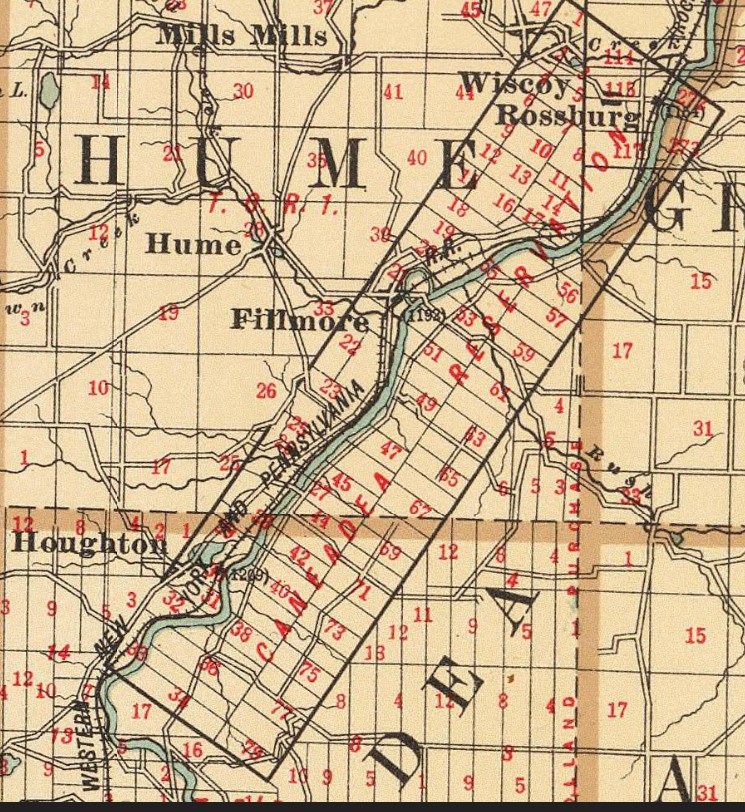
Map showing the Caneadea Indian Reservation 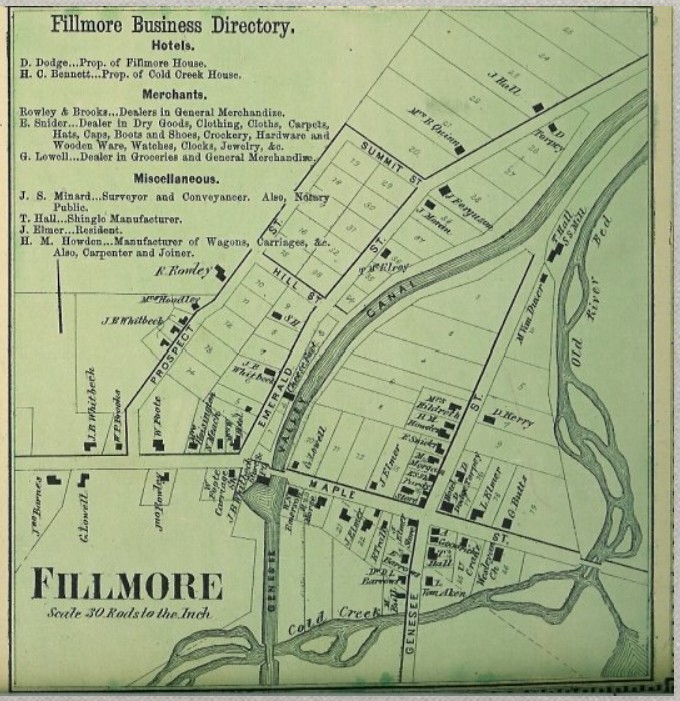
1895 Fillmore Map 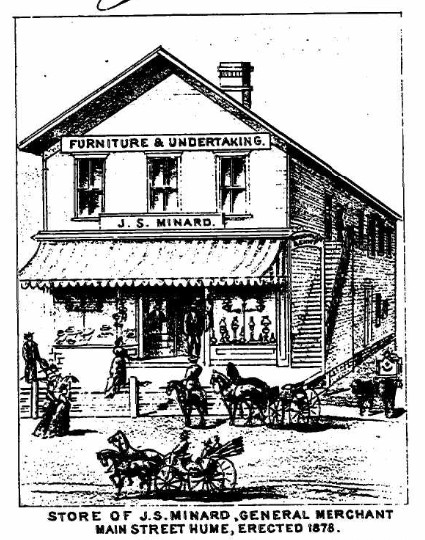
Minard’s Store, 1879 from History of Allegany Co. 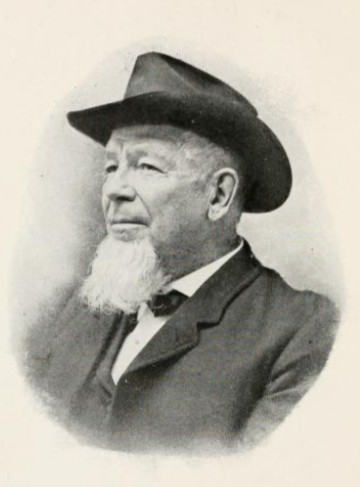
John S. Minard, Life of Major Moses Van Campen 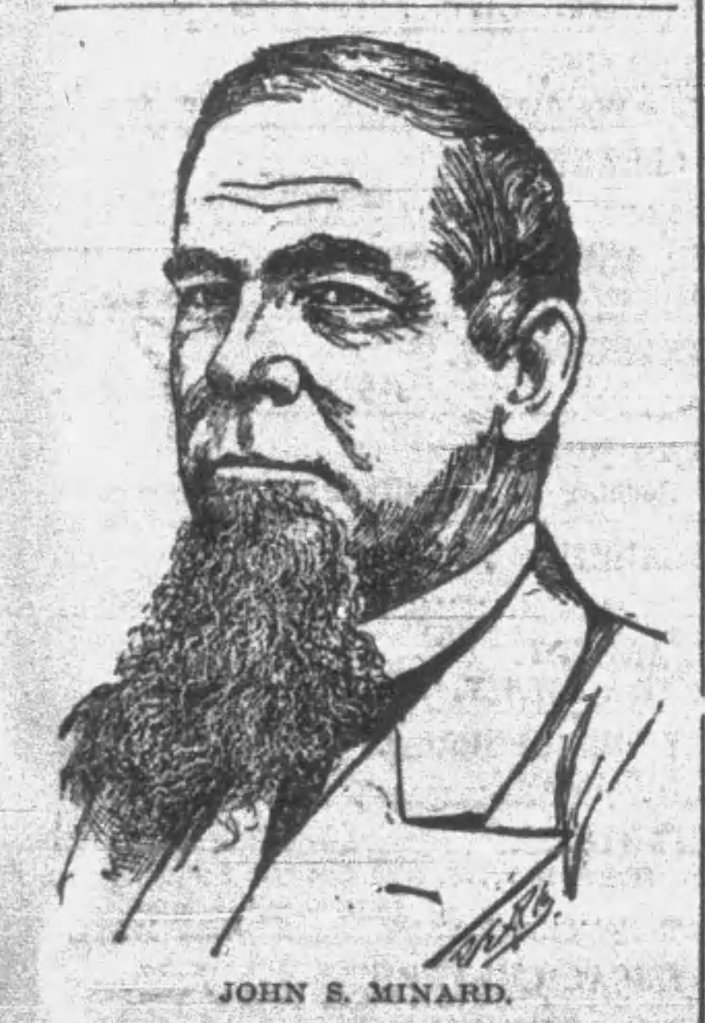
John S. Minard, Rochester Journal and Post Express 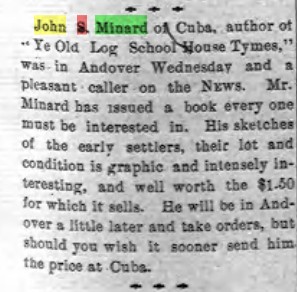
Launch of Ye Olde Log School House, Andover 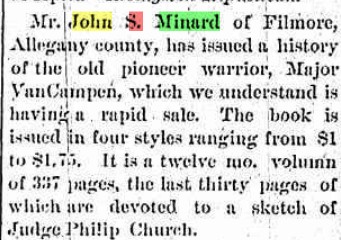
Launch of The Life of Major Moses Van Campen, Nunda News 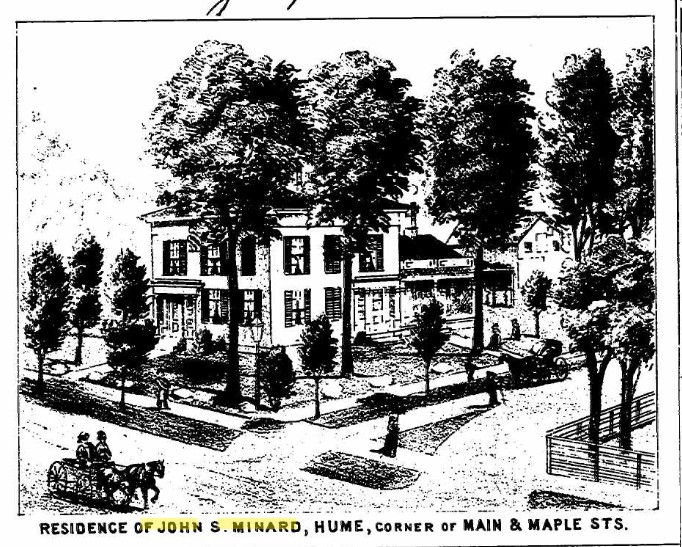
Minard Home 1879 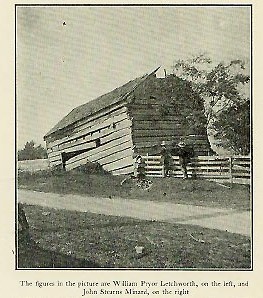
Council House in Caneadea with Mr. Minard and Mr. Letchworth
Resources:
Allegany County Historical Society
Andover News, various years
Castilian, June 1916
Bolivar Breeze, various years
Nunda News, various years
Dalton Enterprise, 1897
Ancestry.com

