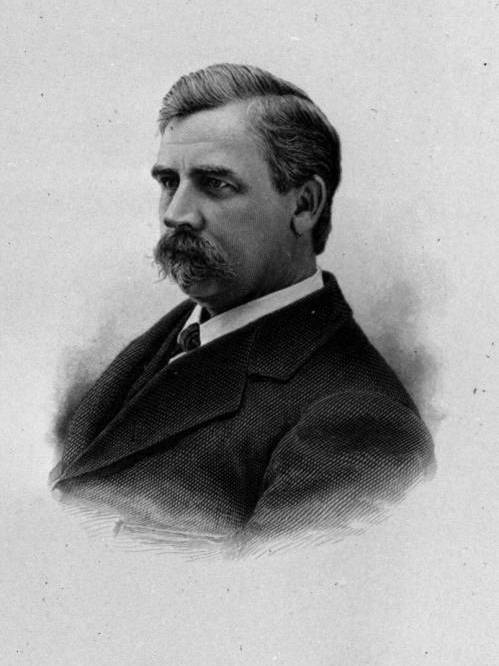
America’s love affair with “natural” remedies and supplements is certainly nothing new. Over 140 years ago, store shelves were loaded with remedies, tonics, and elixirs advertised to cure everything from neuralgia to kidney disease, liver problems, colds, skin problems, and anything else you might have. One of the top patent medicine makers in the late 19th century was Hulbert Harrington Warner of Rochester, New York. At the height of his business, he was making millions on a variety of Warner’s Safe Cures sold around the world. His fall stunned the financial world, and his life faded into obscurity, but it was certainly a fascinating life.
The Early Years
H. H. Warner was born to William and Electa Harrington Warner in VanBuren, New York, on January 19, 1842. He had at least eight siblings, and the family was financially well off. As a teenager, Hulbert was apprenticed to a tinsmith and learned the trade of working with metal, fabricating stoves, stovepipe, pails, basins, and other necessary household items. In 1863, when he received his draft notice to serve in the Union Army, William paid the $300 fee to have him and one of Hulbert’s brothers exempted from military service. By 1865, Hulbert was married to Martha Kinney of Skaneateles, New York, and the couple lived in Lenox, New York. He listed his occupation as “tinner” in the 1865 NY census.
The Rise in Rochester
Warner relocated to Rochester sometime around 1870, and the federal census that year lists his occupation as a safe agent. In fact, he made an excellent living from selling home and commercial safes over the next decade, becoming a wealthy man. But tragedy struck the Warners in 1871, when Martha became seriously ill and died on January 25th. Hulbert soon remarried in October of the same year to Olive E. Stoddard of Oneida County. In 1880, the federal census lists the household with an adopted daughter, Maud, who was six years old. Hulbert was still selling safes.
It was around this same time that health issues plagued Warner, and he said he had Bright’s Disease (an outdated term for kidney disease), which was incurable. With his health failing and death apparently looming, he began taking a patent medicine that was advertised as a natural herbal remedy for his ailment. He said his health greatly improved after taking the medicine for a time, and he decided it was a miracle cure. He contacted the doctor who had concocted the remedy and bought the formula and the proprietary rights to manufacture it. It was renamed Warner’s Safe Liver and Kidney Cure, and sales took off like a rocket. H. H. Warner was a bona fide marketing genius and used contests, free samples, almanacs, newspaper ads, testimonials, flyers, and whatever else came to mind to market his “safe” product. All the labels featured an illustration of a safe, assuring quality and safety. By 1884, his medical laboratories were the largest in the United States, and he had three factories producing glass bottles. The line quickly expanded to other “safe” products such as nerve pills, blood purifiers, a rheumatism cure, rose cream for catarrh (colds), and hair tonic. By the mid-1880s, he was expanding internationally with production facilities in Australia, New Zealand, Canada, England, Germany, and France. He further expanded his line with old-fashioned tonics that sported a log cabin as a logo: Cough and Consumption Remedy, Scalpine (dandruff), Sarsaparilla, Liver Pills, and the mysterious “Extract” for internal and external use. There seemed to be no end to the “medicines” he was able to produce from his laboratories.
He was a man with many interests and loved a good contest. One led to building the Warner Observatory on East Avenue in 1883, a lavish property that included a home for its resident astronomer, Lewis Swift, and a state-of-the-art observatory outfitted with a huge telescope (the 4th-largest in the world at the time). The telescope cost $13,000 and was funded through individual subscriptions, along with an unspecified contribution from H. H. Warner. Fascinated with the discovery of comets, he held annual contests with cash prizes for the astronomer who discovered the most new comets in a year. Another contest was held when he was looking for a stenographer, and he promised a job and $100 in gold to the applicant who could take 250 words per minute for five minutes. It was reported that he spent $400,000 over ten years for advertising, some say much more, and his mail order business was so successful that the mail was delivered in barrels to the grand offices on St. Paul Street, which still stands.
Civic, Political, and Personal Interests
Hulbert lived large during the height of his business success. He built a Victorian mansion, which Arch Merrill calls an “architectural atrocity,” on East Avenue and Goodman Street. You may judge for yourself in the photos below. It was razed in 1929. He collected art from both well-known and up-and-coming artists, filling his walls at home. He loved sailing on the St. Lawrence in his steam yacht, the Siesta, and purchased one of the river’s many islands as a summer residence, entertaining friends and politicians. Mr. Warner also began making risky investments in mining projects and railroads.
A generous donor to the Republican Party, he became the genial “boss” of the party in Rochester, served as a delegate to the 1884 Republican convention in Chicago, and helped with the campaigns of two presidents. In 1888, he was appointed the first president of the Rochester Chamber of Commerce and promised a $20,000 donation to the YMCA if it would build a new facility in the Warner Block in Rochester. With his financial success, he generously gave to many other charitable causes in the area. There seemed to be no end to H. H. Warner’s success and his amazing medicines until the early 1890s.
Decline and Fall
To improve his cash flow, H. H. Warner sold the business to a British investment group in 1889 for $3 million. The caveat was that he would be the managing director and receive a 15% return. However, sales steadily declined, and by the Panic of 1893, the business was doomed, as banks failed, unemployment skyrocketed, and spending dwindled. Creditors were now knocking on Warner’s door for repayment of vast sums of money. His mining investments failed miserably. His balance sheet told a story of undisciplined spending and towering debt. He was accused by the British shareholders of misappropriating funds, and Warner had a weak defense for his use of corporate money. The 22-foot-long telescope at the observatory suddenly disappeared as creditors clamored for compensation and tangible assets. He filed for bankruptcy in May 1893. However, in the midst of these problems, Hulbert managed to marry off his daughter, Maud, on June 2, 1893, to Warner Force Parker, just a day before he sailed to England to answer charges of embezzlement. It’s speculated that this was also the breakup of his marriage to Olive. She went to stay with her sister, who also lived in Rochester, and Olive was part of the household recorded in the 1900 census. Her status was listed as married, and Hulbert was recorded by the census as single, residing in Manhattan, and employed as a manufacturer. The turn of the century also marked the close of the complex bankruptcy proceedings for Hulbert Harrington Warner. The news of the $2 million bankruptcy hit papers around the United States, causing a stir in the financial world.
In May 1908, at age 65, records show that H. H. Warner sailed into New York City from Veracruz, Mexico. He’d been involved in the lumber business for several years in Mexico and away from the curious public. He used his middle name, Harrington, as his first name on the ship’s manifest. Also on the same ship were a woman named Cristina Kaufmann, age 24, and single, and Gustav Recknagel, age 47. In December 1908, Olive Warner died, officially releasing Hulbert from his marital vows. The 1910 federal census records show Hulbert, Cristina, and Gustav living together in Philadelphia, and Cristina’s surname was now Warner. Hulbert listed his occupation as a medicine manufacturer, and Cristina was his adopted daughter. The 1920 federal census has the trio living in Minneapolis, with Warner still listing 36-year-old Cristina as his adopted daughter and his occupation as a doctor. Recknagel was listed as a lodger who was a grocery insurance broker. But however Warner tried to spin the relationship to the federal government, it was general knowledge that they were common-law husband and wife. This odd arrangement continued until Hulbert Harrington’s death on January 27, 1923, at age 81. He was interred next to his first wife, Martha, in Skaneateles.
He had lost all during his meteoric career, and although he remained connected with various patent medicine companies, he never recovered financially. His true adopted daughter, Maud, had also died tragically on November 16, 1897, just two days after giving birth to a son. His obituary mentions only one relative, a nephew, remaining in his family with no mention of his grandson, who lived until 1966. After Hulbert’s death, Cristina, who was a Mexican national and a U.S. naturalized citizen, was listed in the Minneapolis City Directory as the widow of H. H. Warner. It is believed her maiden name was de Martinez, and her background is unknown. She continued to live with Gustav in Minneapolis until his death in 1934. The mysterious Cristina died in April 1949.
Secret Formularies Revealed
In the heyday of patent medicines, ingredients were not required to be listed on the label, nor was there any government oversight of the industry. But the Pure Food and Drugs Act of 1906 ended the use of secret ingredients, required manufacturers to list all ingredients, and prohibited advertising that made false or misleading claims about a product’s efficacy. It was common practice for patent medicine makers to include alcohol, cocaine, heroin, and other addictive drugs in these “medications.” It wouldn’t be until the 1938 Federal Food, Drug, and Cosmetic Act that ingredients needed to be deemed safe for over-the-counter use.
So what was in Warner’s Liver and Kidney Safe Cure? The Journal of the American Medical Association (AMA) revealed the ingredients in its scathing article on Warner’s products in 1914: extract of Lycopus virginiana (bugleweed), extract of liverwort (common weed), extract of wintergreen (flavoring), potassium nitrate (saltpeter), glycerin, 90-proof alcohol, and water. None of the ingredients was effective in treating any illness, especially if one truly had kidney or liver disease, and it was harmful to all who took it. The article further stated that if the Safe Cure was taken as directed, it was like taking shots of whisky throughout the day and revealed Warner’s connection to Kentucky distilleries.
The AMA further stated that Warner’s products were fraudulent, harmful, and preyed on fearful customers. Warner’s advertising warned about back pain, sediment in urine, and other false symptoms for the eager self-diagnosing public, which led to his great success.
H. H. Warner had nothing to do with his company after he filed for bankruptcy, and the management tried to repackage and improve the sullied image without much success. The last advertising for Warner’s Safe Cure I was able to locate was in 1914, but there were articles exposing the fraudulent claims well after 1914, although European doctors had warned of its dangers in the 1880s. In the end, Hulbert Harrington Warner’s life was very much like the comets he so admired: a great flare of light in the sky that disappeared into the dark.

Observatory Interior, Democrat & Chronicle, 1923 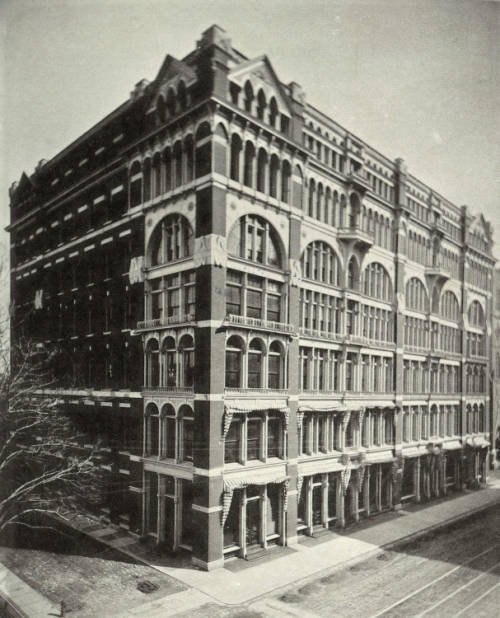
Warner Building, Courtesy NY Heritage, Rochester Public Library 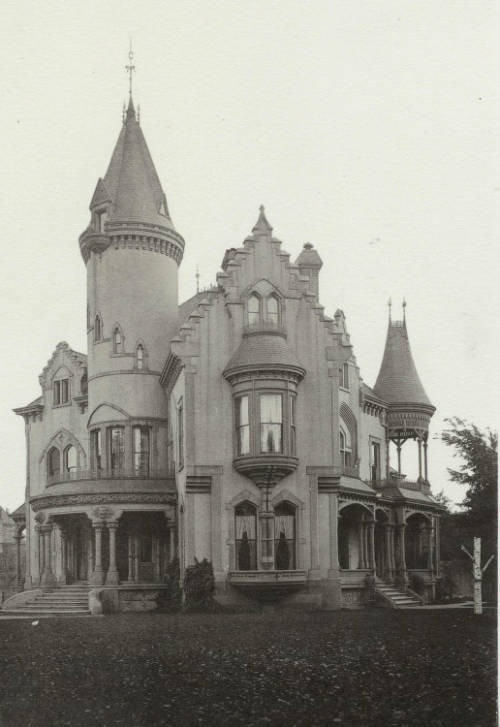
Warner Home, Courtesy NY Heritage, Rochester Public Library 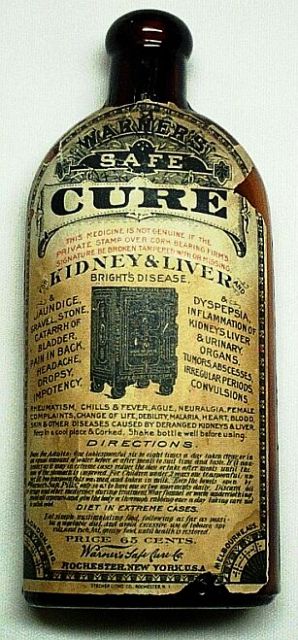
Courtesy Warners Safe Blog 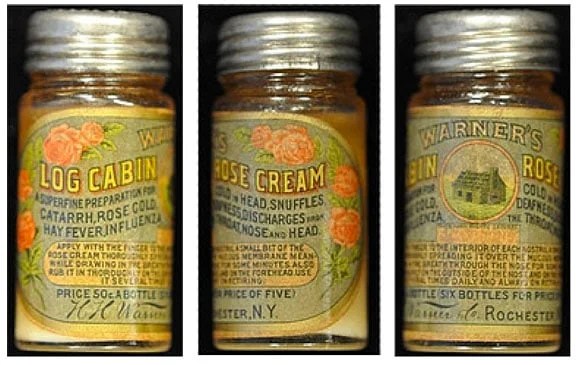
Courtesy Warners Safe Blog 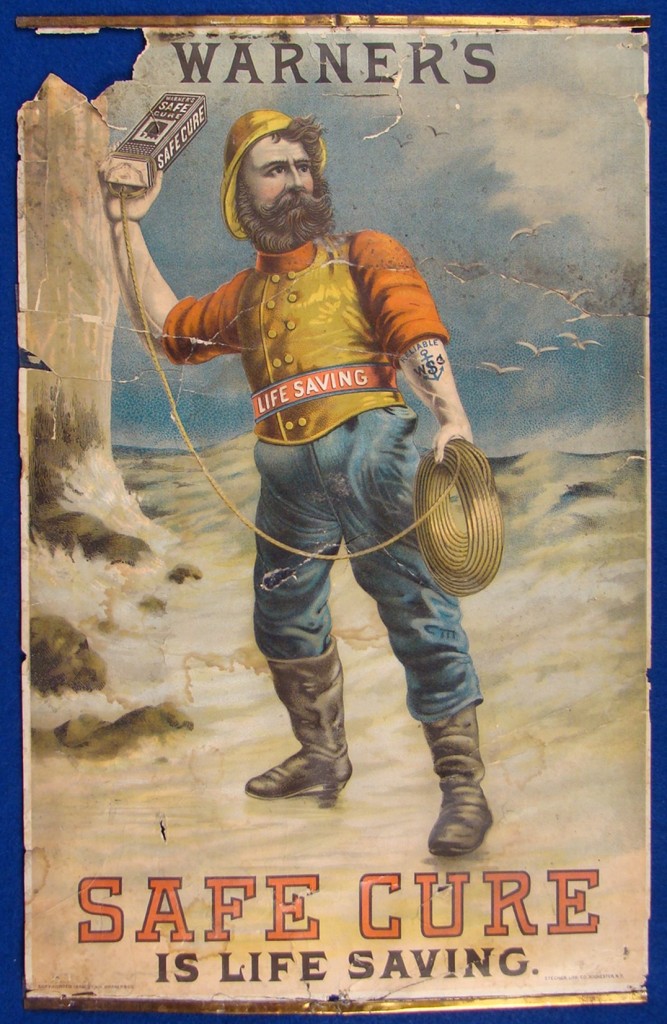
Courtesy Library of Congress 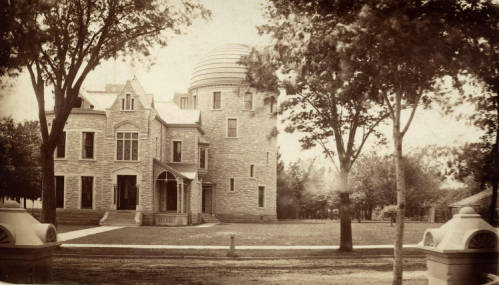
Warner Observatory, Courtesy NY Heritage, Rochester Public Library 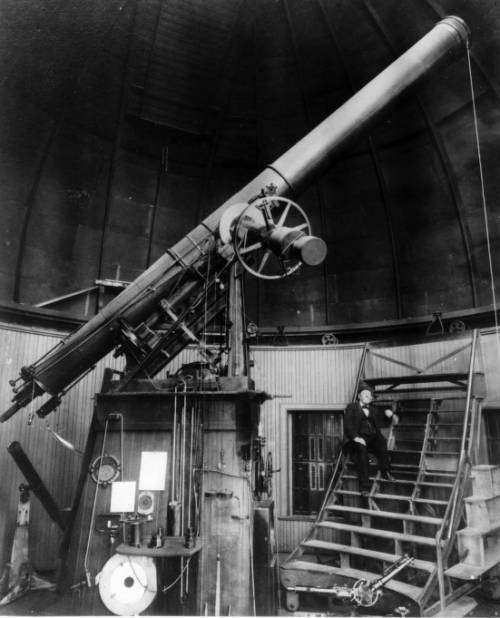
Louis Swift in observatory, Courtesy NY Heritage, Rochester Public Library 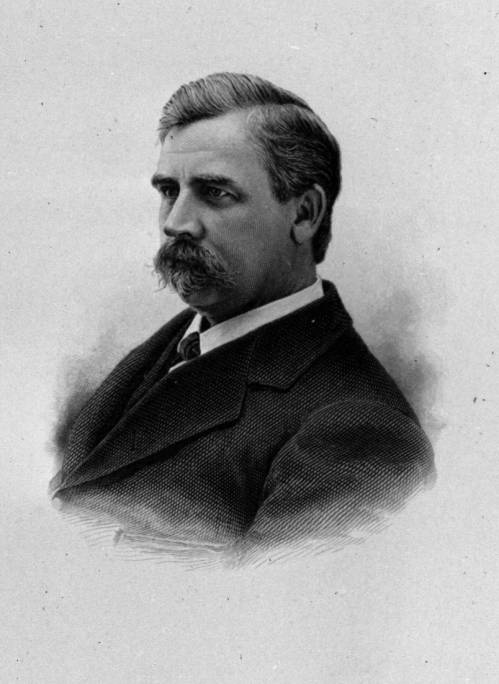
H. H. Warner, Courtesy NY Heritage, Rochester Public Library 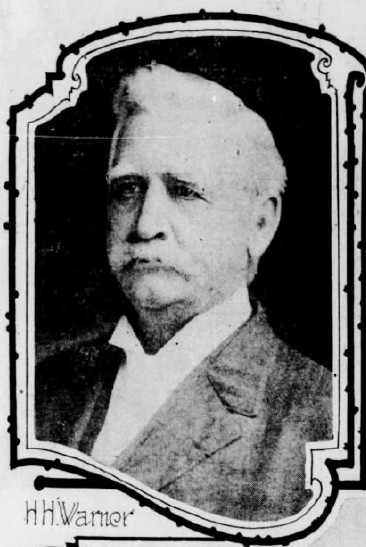
H. H. Warner, Democrat & Chronicle 1923 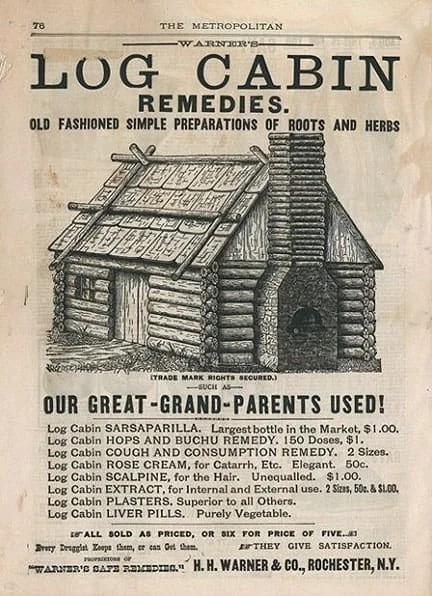
Log Cabin Advertising 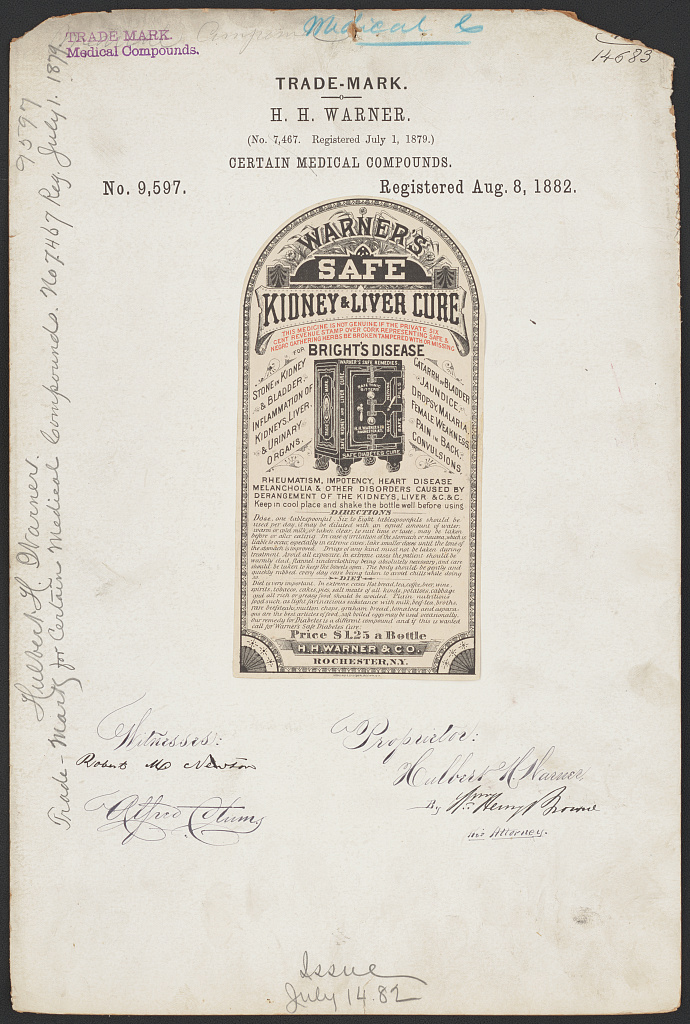
Trademark Registration Courtesy Library of Congress 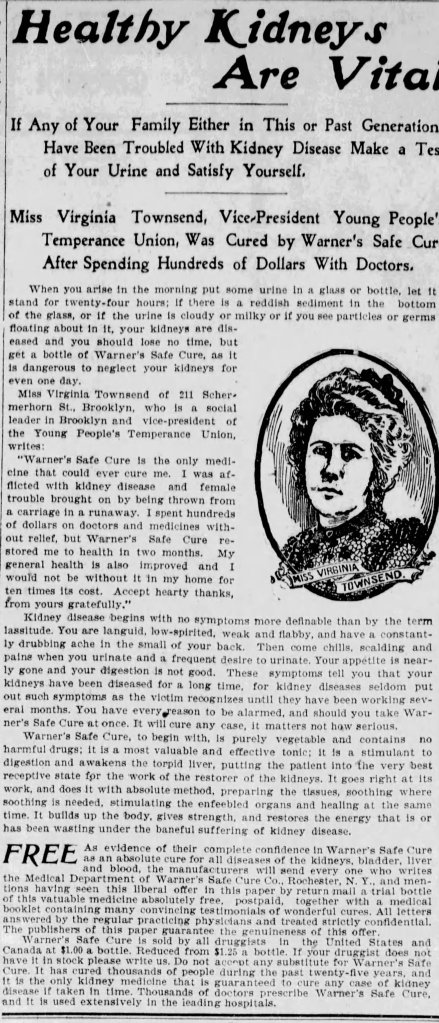
Advertising in Buffalo News 1901

