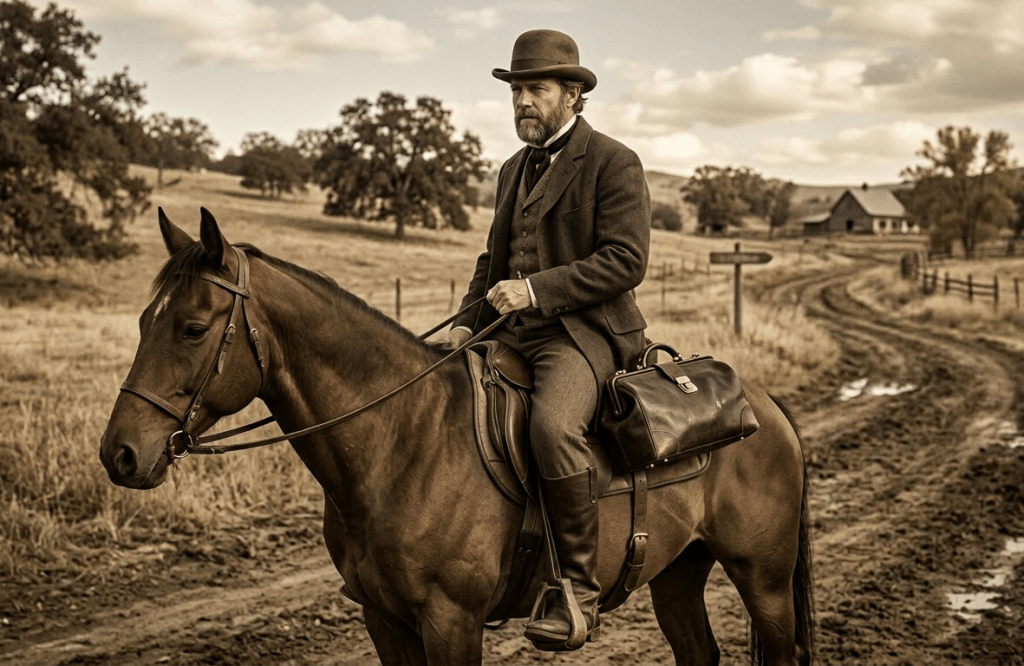
Most of us regularly visit our “eye doctor” once a year for a checkup, and consider cataract surgery a rite of passage in the aging process. Laser surgeries and other treatments for vision issues are the norm, and from the optometrist to the retina specialist, we can expect to find help to preserve and improve our precious vision. In the early 1800s, there were no eye specialists, and very few specialists in any field of medicine. But that changed when Dr. Edwin G. Munn began practicing in Scottsville, New York, in 1828.
Edwin George Munn was born April 7, 1804, in Munson, Massachusetts. It is believed he had at least one brother, John, and two sisters, Emily and Fanny. The family relocated to LeRoy, New York, and the Munn children grew up in the village. After Edwin finished school and expressed an interest in medicine, Dr. Stephen Almy, the local physician, began Edwin’s medical training. Showing a great deal of aptitude, Dr. Almy encouraged him to pursue formal medical education.
He enrolled at the College of Physicians and Surgeons located in Herkimer County, Fairfield, New York. This college was the first medical college chartered in New York State west of the Hudson River, receiving its credentials in 1812, and it closed its doors in 1841. In 1828, at age 24, Dr. Munn opened his practice in Scottsville, New York. Edwin went on to the University of Pennsylvania in Philadelphia between 1833 and 1834, completing his medical training and returning to his Scottsville office. That year, he also married Aristeen Pixley of Chili, New York, on October 28th.
His practice was a success, and during this time, he began to focus on eye diseases and specialize in treatments for various eye maladies. Dr. Almy had prodded him during his early training to consider such a specialty, since he was continually frustrated by his inability to treat the multitude of vision problems among his patients. As he continued to study the anatomy of the eye and tried to solve the problems of cataracts, glaucoma, and eye injuries, a young girl by the name of Hattie Abell was brought to him for treatment. She was from Fredonia, New York, and her brother and parents drove her to Scottsville in a cutter (a one-horse sleigh), a distance of over a hundred miles. Dr. Munn was called to the Eagle Hotel in Scottsville to examine Hattie, who’d been blind since birth with congenital cataracts. The family was desperate for her to regain her sight, as was the young teen. Hattie wrote of this first encounter with Dr. Munn.
“My mother asked if he could make me see again, and he said, “Yes, I’m going to make her see like a rat!” Hattie then wrote, “This braced me up a good deal.”
When Mr. Abell told Dr. Munn he’d considered taking Hattie to New York City, the good doctor told the anxious father, it was a good thing he’d come to him instead, because he believed his daughter wouldn’t have any sight at all if treated by the city doctors. Thus began a series of operations over two years, with nine on one eye and three on the other, to restore Hattie’s sight. It was all done without anesthesia, and she wasn’t restrained. Her mother feared she would move during the surgery, but Hattie recalled that she was so anxious to see that she wouldn’t have moved “if he had taken my head off.” Hattie stayed with Dr. Munn’s family, and people from all over the region came to talk with her and see the success of the surgeries. After the second surgery, she had some sight, and by the end, she could indeed “see like a rat.”
Dr. Munn was known for his kindness, compassion, and generosity. Most of his patients were poor, and many times he took no fee, housing them and paying for their transportation home out of his own pocket. Patients came from all over the United States—Arkansas, Illinois, Missouri, and many others. As many as a hundred patients would be waiting to be seen by him each day, a line of people outside his offices waiting their turn with the doctor. The constant pressures of the practice didn’t make family life with his son and daughter ideal. In 1837, he moved his office to the Smith Arcade building in Rochester, and in 1843, he purchased a farm in Gates, which he named Paradise Hill. He was now able to devote himself more fully to his domestic life in this rural setting and to relax after his long days in the city.
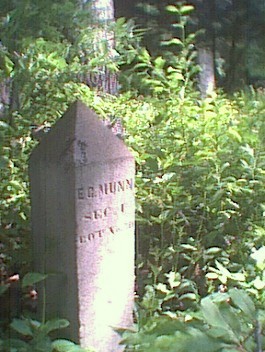
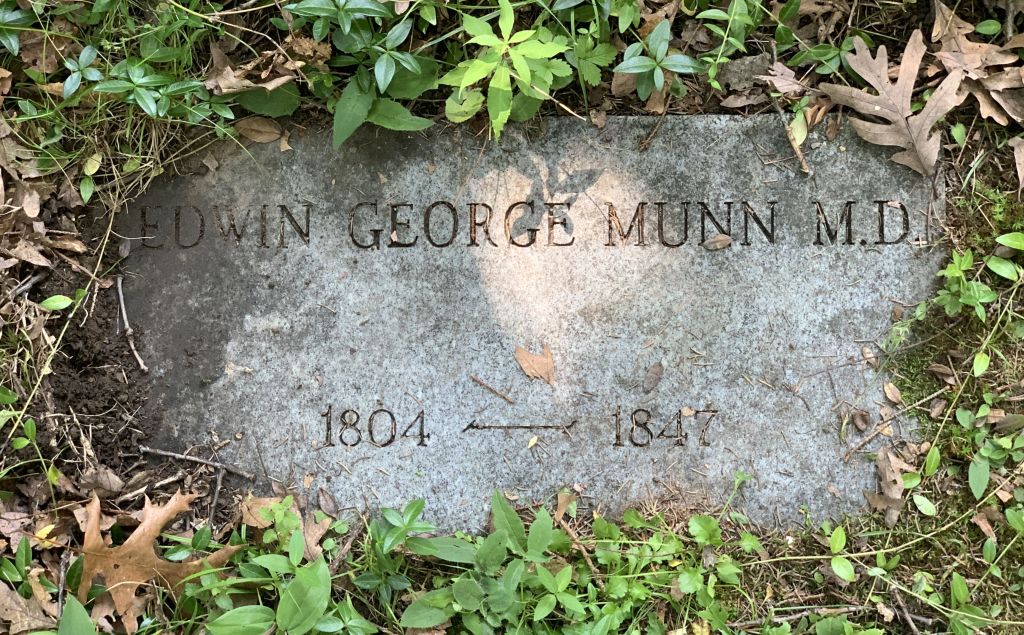
The Munns had three children: a son, Jason, who died in infancy; a daughter, Frances Emily, born in 1844; and a son, John Pixley, born in 1846. Unfortunately, Dr. Munn never saw his children grow up, for in December 1847, he was suddenly taken ill and died on December 12, 1847, at age 43 from a bowel obstruction, and he was buried in Mt. Hope Cemetery, Rochester. He left a legacy of helping many people regain their sight, putting one patient through medical school, and paving the way for the ophthalmologists who followed after him. He was the second known ophthalmologist in the United States at the time of his death, being preceded by Dr. George Frick of Baltimore.
In the History of Rochester and Monroe County, he was praised as “a man of strong intellectual force, of kindly spirit and generous disposition, and was greatly esteemed in the community where he lived by reason of his many excellent traits of character.”
Resources:
Genesee Valley People 1743-1962, Irene A. Beale.
History of Rochester and Monroe County
LeRoy Historical Society
A Century of Medicine in Rochester, Betsy C. Corner
1840 Federal Census
Findagrave.com
Rochester Public Library
pdfs.semanticscholar.org

