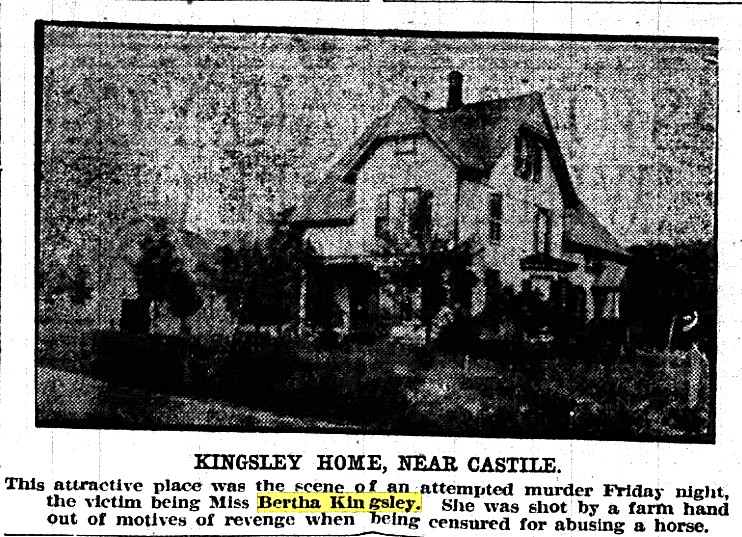
The news is filled with senseless crimes—road rage that turns deadly, an argument that results in someone being shot, and random assaults. But it’s nothing new, and the story of 23-year-old Martin Swoboda shooting 21-year-old Bertha Kingsley on a fine June afternoon in 1907 is an example of senseless violence.
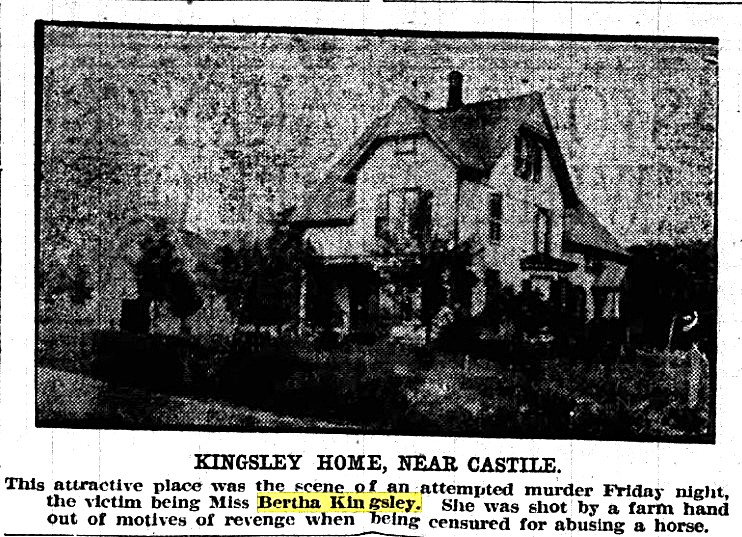
The story unfolds on Earle V. Kingsley’s farm located just south of the village of Castile on Route 39. In fact, the now-defunct farm is located less than a mile from where I lived for many years. Earle Kingsley and his son, Charles, ran the farm and had several hired men throughout the summer months. One of these men was Martin Swoboda, a Hungarian immigrant, whom Mr. Kingsley had secured through an agency in New York City two or three years earlier. He’d paid Swoboda’s expenses to travel to Castile, and had consistently given the man work.
Earle Kingsley later testified that Martin Swoboda regularly ate his meals at the Kingsley family’s table, and was treated like a family member. The farmhand was also taught to speak English with help from the family, especially Bertha. But this amicable relationship was shattered on June 21, 1907.
The weather was fine, and Earle gave out work assignments to his men for the day. They were all sent with teams of horses to make road repairs near Denton’s Corners. Breakfast was served to the men by Earle’s daughter Bertha and his wife, Susie (Bertha’s stepmother). The women had also packed lunches for everyone, but Martin refused breakfast, and he neglected to pick up his lunch before heading off with a team of horses he’d complained about the day before. He would say later that he felt grouchy. After arriving at Denton Corners, co-workers saw Martin drive off toward Lamont, telling them he’d forgotten his lunch and was going back for it. It was later learned that he stopped at the Moore Hotel in Lamont and drank some beer with the owner, Joe Moore. He then headed back to the Kingsley farm, and when he arrived in the yard, Bertha saw him whipping the horses for no reason. She stepped outside and reprimanded him to stop mistreating the team. Minutes later, a sullen Swoboda appeared at the door. He informed Mrs. Kingsley he was quitting and wanted his clothes, which were given to him. Swoboda then walked to the nearby Bevier farm carrying his belongings.
After the strange departure of Swoboda, Mrs. Kingsley became uneasy about the man’s demeanor and rang the operator to put a call through to Sarah Billings, Bertha’s grandmother in Castile. She asked the older woman to come over and keep them company since she and Bertha were alone in the house, and she had a bad feeling about Martin Swoboda. Sarah came at once, but Mrs. Kingsley’s fears only grew as she saw Martin back on the property, going in and out of the barns. It was now late in the afternoon, and her husband still wasn’t home. About five o’clock, the farmhand was back at the door asking for a pair of leggings he hadn’t received back. Mrs. Kingsley quickly located them and handed them to the man, firmly shutting the screen door. But minutes later he was back asking for a pair of overalls that he’d left in the bedroom. This time, Bertha went to find the clothing, and as she returned to the door, Martin Swoboda raised his hand, revealing a revolver and shot through the screen at the young woman. In her panic, Bertha ran past the man into the yard and started across the road. Swoboda chased the young woman, shooting at her as she fled. Screaming for her grandmother to open the door, Bertha turned back to the house, now calling out, “I am shot!”
Mrs. Billings opened the door for her granddaughter, fully intending to close and lock it before her assailant could enter. But Swoboda barged through after Bertha and began hitting her in the face with the butt of his gun, knocking her to the floor. He then attempted to reload the gun with the obvious intention of shooting the women, but clumsily scattered the bullets. Mrs. Billings began hitting the man and yelling, as Mrs. Kingsley grabbed her husband’s shotgun from the rack. Swoboda fled, running up the road toward Lamont.
Bertha was severely wounded from a gunshot wound and the pistol whipping, and her stepmother frantically called the operator for medical help. A Mrs. Snell from Lamont was driving her buggy past the house and, seeing the commotion and the man running away, turned around to inform Mr. Kingsley, who was working toward Lamont. But before she reached his location, she met Deputy Sheriff Charles O. Locke, and told him about the shooting. When Deputy Locke arrived at the Kingsleys’, a crowd had already gathered. Farmers and villagers were in the yard armed and ready to search. Deputy Locke first called the operator to connect him with the Allegany County Sheriff to warn him to be on the lookout for the fugitive. Then he took the shotgun from Mrs. Kingsley and headed toward the woods, but was met by four men just coming out of the trees.
“We’ve searched, but he’s not in there,” one of the men declared. Charles Locke wasn’t convinced and plunged into the thick undergrowth around the woods. Within minutes, he spied a man moving through the trees. Cocking both barrels of the shotgun, Locke ordered the man to come out with his hands up. It took a second order before the man put up his hands, but when the deputy was within a few feet, Swoboda dropped his hands as if to pull out a gun. Locke rushed him, striking him in the head with the shotgun barrel. Swoboda fell to the ground, and within minutes Locke, with the help of others, tied up the prisoner and deposited him in Locke’s buggy to be taken to the Castile jail.
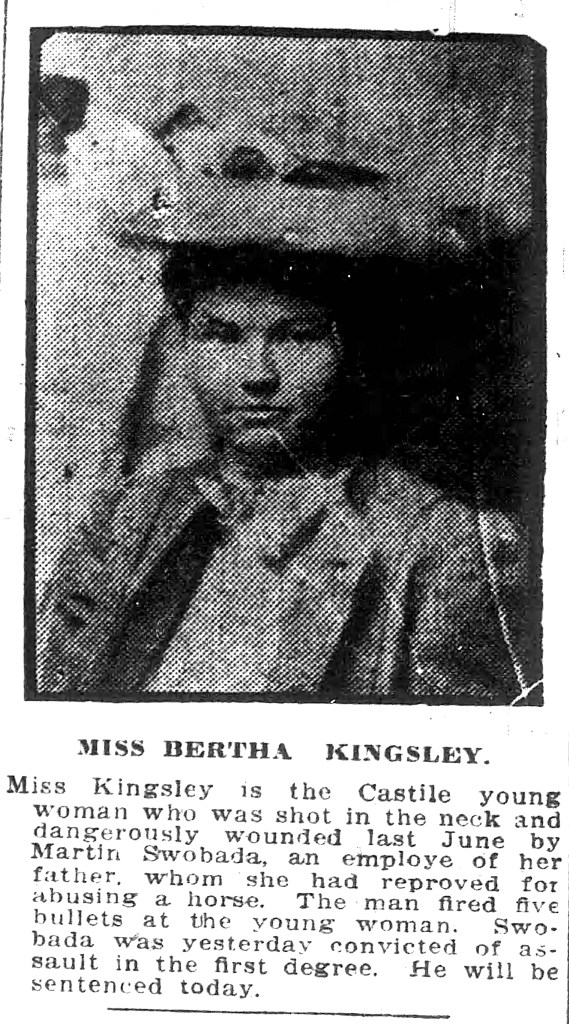
Meanwhile, two doctors were treating Bertha, who had suffered a bullet graze to her head, besides the beating, plus a gunshot wound that had entered her back, gone through the top of her lung, and had lodged in her neck. She was considered to be in critical condition, and the bullet couldn’t be removed safely because of its location. Drs. Miller and Harding couldn’t say whether the young woman would make it or not. The next 48 hours were crucial.
Local residents were fuming, and there was an undercurrent of conversation about what should be done about the crime. An old-fashioned lynching was even mentioned, and law enforcement was already nervous about citizens trying to get into the jail. Bertha was well-loved in the Castile community—a woman with a reputation for kindness, helpfulness, and community involvement.
Martin Swoboda was despondent in the jail cell and began complaining of a terrible headache. By then, Sheriff French had arrived from Warsaw on the evening train and went with the prisoner to Dr. Lyman Broughton’s to have the head wound dressed. There it was found that besides bruising from the shotgun barrel, the man had shot himself over the left eye. It apparently wasn’t considered serious. He was then taken before Justice Edmund B. Windsor. Since Swoboda’s English was limited, but he spoke German, John Schroeder was brought in to translate the arraignment proceedings. When asked if he killed Bertha, the man replied that he hadn’t and that she would live. When asked why he shot her, he lapsed into a stupor and then asked for water. He refused to say more. By midnight, a crowd was gathering near the jail, and the sheriff requested an automobile be located to transport the prisoner to Warsaw. Soon, Martin was whisked away to the Wyoming County Jail in Warsaw.
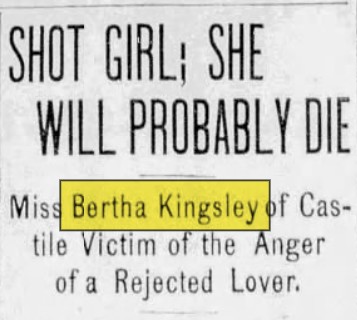
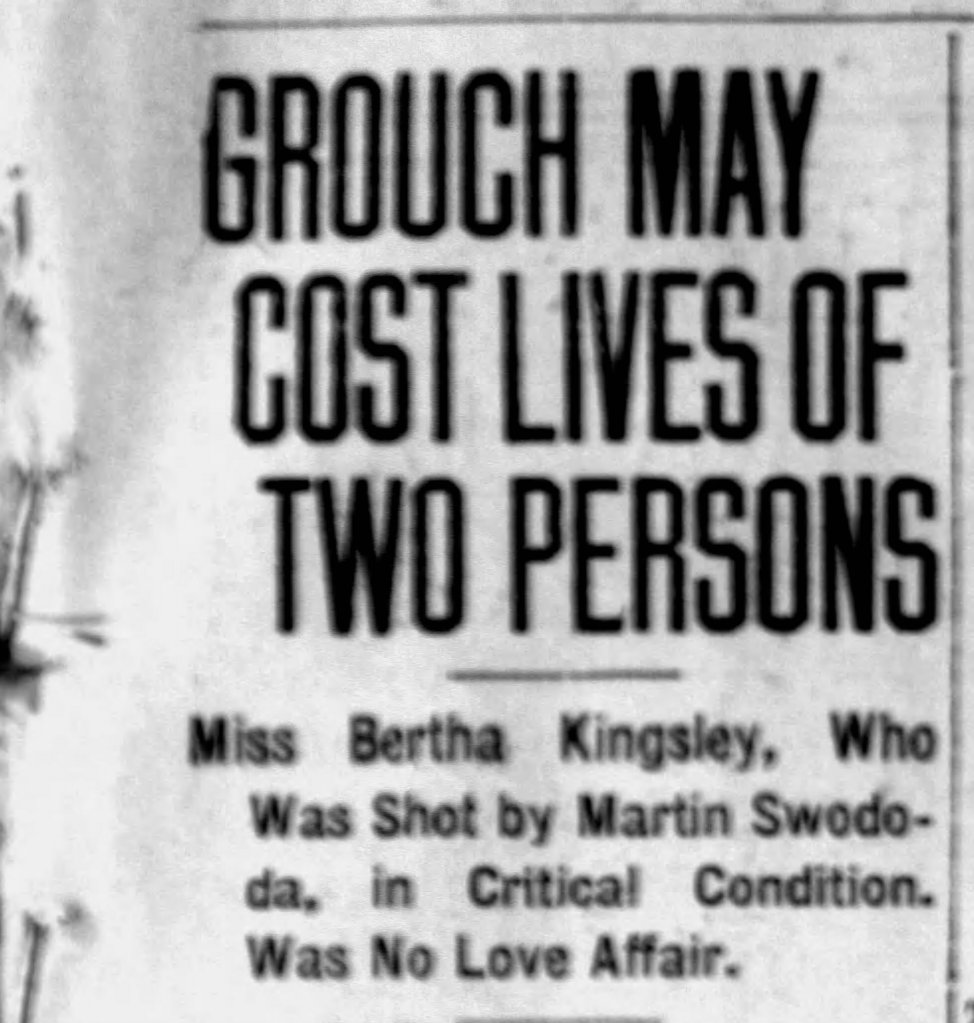
As one would expect, the media frenzy was huge about the violent attack, and some of the first reports said that Miss Kingsley had refused Swoboda’s romantic advances, leading to the desperate act, but within a day, the papers reprinted a retraction. There was no such love affair, and Earle Kingsley wasn’t having his daughter’s reputation smeared in the press. It was several weeks before Bertha was well enough to be out of the house, and the Wyoming County Times reported that at the end of July Miss Kingsley was taking carriage rides around the village. The bullet remained lodged in her neck, however.
Martin sat in the county jail over the summer until he was indicted for first-degree assault in October 1907. He pleaded not guilty, and the trial was set for the November term. Chester A. VanArsdale was the assigned attorney for the defendant. The Honorable James E. Norton was the presiding judge, and jury selection went smoothly on November 19. The Kingsley family testified first, and when under cross-examination by Mr. VanArsdale, it quickly became clear the defense strategy was insanity. Earle Kingsley stated clearly that he’d never seen any signs of insanity over the three years that the man had worked for him.
Besides the doctors who cared for Bertha and the defendant’s co-workers, a clerk from a Silver Springs store was called, and his testimony was a devastating blow to the defense. Lewis E. Danforth, clerk at Marsh’s Store, testified that about 1:30 p.m. the day of the crime, Martin Swoboda came in and purchased a .32 caliber revolver and ammunition. Multiple witnesses also testified that the defendant had obviously been drinking for the better part of the day.
When Attorney VanArsdale began his defense, he stated that there was no argument that the assault had taken place, but Mr. Swoboda had been insane at the time of the shooting. Martin Swoboda took the stand and, in halting English, told the court that there was a history of insanity in the family. His father, sister, and an uncle had all been institutionalized because of it. However, no proof was offered by the defense to confirm the story. As to why he bought the gun, he said that he’d gotten it for the 4th of July. He said he’d been grouchy that day because of the team of horses he had to work with. Swoboda further testified that he had no memory of the attack on June 21, since he’d had headaches all that day. He also couldn’t give a motive for the crime and never verbalized regret for his actions.
The jury spent three hours deliberating and returned a guilty verdict. Judge Norton sentenced Martin Swoboda on November 27 to not less than eight years and not more than nine years and 10 months at Auburn State Prison. He went from the courtroom to the depot to catch a train to prison. The Auburn prison records described the prisoner as 5’ 4” tall and 163 pounds, and that he’d arrived in the United States in May 1904.
Bertha Kingsley’s health remained precarious until her death on September 16, 1932. However, she didn’t allow the incident to make her bitter or turn her into a recluse. Although she never married, she was active in the Castile Grange, the Methodist-Episcopal Church, and other community activities. She cared for her Grandma Billings in her final months, and was a beloved hostess for bridal showers and parties. But illness was always a factor in her life and would keep her housebound for long periods of time. The Perry Record reported in 1919 that Earle had purchased a collie for her from New York City to keep her company since she’d been at home for almost two years because of poor health. She was a patient at the Castile Sanitarium at least once for several weeks in 1920. Just three years before her death, the bullet was finally removed from her neck, but sadly she died at age 46 after another lengthy illness.
Martin Swoboda was released from Auburn on March 6, 1913, not serving his full eight-year sentence. What happened to him is unknown, although a Martin Swoboda is listed as a laborer living in Otisco in the 1927 Syracuse city directory. It’s quite likely he was deported to Hungary, which was common practice with convicted felons who weren’t U.S. citizens. Whatever the case, his senseless act because he was having a bad day carried lifelong ramifications for his victim.
Resources:
Federal Census Records 1900, 1910, 1920, 1930
New York State Census Records 1915
Democrat & Chronicle, June 21, 1907, November 1907
Silver Springs Signal, June 1907, November 1907
Wyoming County Times, June, October, November 1907
Perry Record, May 1919
Buffalo Illustrated Times, June 23, 1907
The Castilian, June 1907, November 1907, September 1932
Ancestry Kingsley Family Records

