
Part Two
The first-person accounts from the diaries of officers with General Sullivan give us a front-row seat to the gruesome scenes these men found as they advanced to Little Beard’s Town. Once again, Major James Norris describes what happened next: 13th of September, 1779: “…a Party of Riflemen and some others 26 in Number, under the Command of Lieut Boyd of the Rifle Corps was sent out last night to a town 7 miles from here, to make what Discovry he could and to Return at day brake—4 of his men went into the town and found it abandoned, but found 3 or 4 scatering Indians about it one of which they killd & Sculp’d, then Return’d to Lieut Boyd—after sunrise who lay at some Distance from the town—he then sent 4 men to Report to General Sullivan what he had Discover’d and Moved on slowly with his party…”
Major Jeremiah Fogg’s diary entry offers more information on the 13th of September, 1779: “The preceding evening, a party of four riflemen and Honniose, an Oneida Indian, were ordered to reconnoitre the next castle and return by day-break. But by mistake twenty nine went, four of whom discovering four Indians in the town, killed and scalped one and wounded the second. The officer (Lt. Boyd) instead of returning, as was expected, sent four of his men to inform the General, detaining the remainder until the army should arrive; but, hearing some Indians had been discovered near by, marched down and was drawn into an ambuscade wherein Boyd, and about twenty men were cut off.”
The site of the ambush was near Conesus Lake, and 14 of Boyd’s men were immediately killed, with seven managing to escape. Boyd and Parker were taken as prisoners. Lt. Colonel Butler intended to take the Americans as prisoners of war to Fort Niagara. However, by the time the POWs reached the Genesee River and were close to Little Beard’s Town, the Senecas had no intention of escorting the Americans to Fort Niagara. Little Beard had already decided that the men would die. Of note, one of the inhabitants of Little Beard’s Town was Mary Jemison, who had five children at that time. She described the events during September 1789, including the torture and killing of Boyd and Parker. The women and children of Little Beard’s Town were directed to leave and to head toward what is now Varysburg to escape Sullivan’s Army. They returned after Sullivan headed eastward, but Mary, who witnessed the complete destruction of homes and food supplies, immediately took her children to the Gardeau Flats, where she was able to feed them and find shelter. This place became her permanent home.
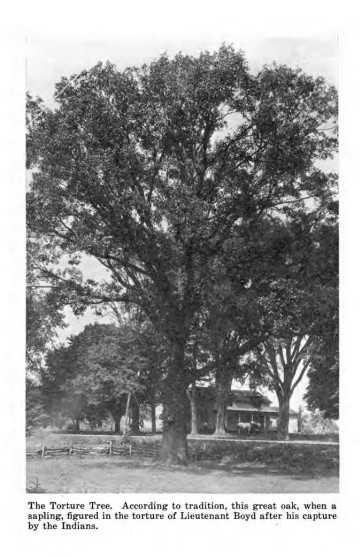
The mistake of Lt. Boyd in not returning with the scouting party as expected led to his agonizing death, along with Sergeant Michael Parker. The diary entries of the officers recorded the horrible scene when the bodies of Boyd and Parker were found near the Genesee River. Both had been beheaded, their eyes and tongues cut out, and as Major Fogg wrote, “every species of barbarity committed” upon the remains. Although there is local lore that the men were disemboweled and made to run around the “Torture Tree” until they died, none of the diaries of the men who found the bodies mention this atrocity, and much detail was offered in these journals. However, the Senecas exacted a horrifying revenge upon the Lieutenant and Sergeant who had stepped into a massive ambush of about 400 Indians.
Boyd and Parker were buried with full military honors at the site where they were found, which was near an oak tree not far from the river. Their remains were later reinterred at Mt. Hope Cemetery, Rochester, New York, in 1841 by Governor William Seward. There is a massive oak tree in the park today, called the Torture Tree, which has been certified to have been alive during the time of Sullivan’s Campaign. However, it would have been relatively small in 1779.
Sullivan’s army reached Chenussio or Little Beard’s Town on September 14th, destroying the large town of 128 houses, vast fields of corn, melons, squash, and other crops, and extensive orchards. Believing this was the final Seneca stronghold west of the Genesee, Sullivan turned his troops east back toward Seneca Lake, destroying any villages they’d missed on the campaign west. It was on their way back that the other bodies of the scouting party were discovered and buried.
That fall, over 5,000 Six Nations peoples arrived at Fort Niagara, begging for assistance from the British. Although Indian forces would once again rise against the American settlers in 1780, the campaign had successfully broken the back of the Iroquois Confederacy and their ability to be self-sufficient. Thousands of acres of crops were destroyed and 40 towns obliterated, leaving thousands homeless. At the end of the war, the British turned their backs on their Six Nations allies, leaving them to make their own arrangements with the new American government.
In times past, there have been celebrations honoring the sacrifices made for American liberty by Lieutenant Thomas Boyd and Sergeant Michael Parker. The most significant was in 1841, when the remains were reinterred at Mt. Hope Cemetery. Major Moses VanCampen, who was 80 years old at the time, was present at Cuylerville to place the urn which contained the men’s bones into a sarcophagus to be taken to Rochester. Major VanCampen, who had known Boyd as a boy in Pennsylvania and had served with him in Sullivan’s Campaign, paid his final respects to his classmate and fellow soldier. Several other Revolutionary War veterans were present that day and were seated in places of honor on the platform during the ceremonies.
The Boyd and Parker Park may have a gruesome history, but it honors the sacrifices of men fighting for their country, who bravely gave the ultimate sacrifice that we might enjoy a free nation today. As the plaque in the park states: This wayside shrine marks the place where on September 14, 1779 two young soldiers of the Revolution Lieutenant Thomas Boyd and Sergeant Michael Parker met death undaunted in the line of duty. Under lingering torture they marked with their blood the western limit in the State of New York of the great struggle for American freedom.



Resources:
Journals of the Military Expedition of Major General John Sullivan
Boyd and Parker, Heroes of the Revolution, Livingston County Historical Society
 Along the Genesee
another good writeup Laurinda!
LikeLike
Thanks, Than!
LikeLike