
The Castile Sanitarium, which drove the economy of the Village of Castile for more than 60 years, hosted a long line of remarkable women over its storied history. Besides Frances Willard, President of the Women’s Christian Temperance Union, and Susan B. Anthony, the leading suffragette of her time, there were socialites, authors such as Isabella Alden, artist Frances Judson, ministers’ wives, homemakers, and teachers who came for the “Water Cure” in Castile from the time Dr. Cordelia A. Greene became the director in 1868.
Frances Bennett Callaway was one of these interesting women. She was plagued with a frail and nervous constitution, becoming a patient of Dr. Greene in 1885. Like many who followed after her, Frances became enamored with the picturesque village, later making Castile her home.
Frances was born to Margaret and Charles Dilts of Livonia on September 20, 1852, and her sister, Lillian, was born the following year. Her father died in 1856, and Margaret married Dr. Lewis Howell Callaway in 1858. He was a widower and had lost a daughter before he adopted the young girls in 1863 with no other children born to him and Margaret. Callaway was from Missouri, and the small family lived there and then in Macoupin County, Illinois, where “Frankie,” as her adoptive father affectionately called her, often accompanied him on house calls. She was a sympathetic presence, learning that a kind word or a fistful of flowers often brought more healing than medicines. A childhood accident caused an undisclosed disability, which left her with mobility issues and bouts of poor health. She didn’t focus on her problems and was known as cheerful and selfless throughout her life. Encouraged to write by her mother, Frances felt she’d found her calling as she penned short articles about daily life.
Dr. Callaway died from consumption in 1870, followed by Frances’ mother and sister a few years later, leaving the young woman to make her own way. She returned to New York State and lived in Mt. Morris with an aunt and uncle on several occasions; she also attended Oberlin College to hone her writing skills further. Frances also traveled solo to England, immersing herself in the great libraries at Oxford and London. An independent woman with a good business head, she determined to make her living from writing and began selling articles to magazines. However, she was especially interested in teaching the art of letter writing, whether correspondence between friends and family or business letters. This topic became the centerpiece of her writing career around 1885.
She began a correspondence course to teach letter writing and communication, which brought her students from around the state and past those borders. Teachers, artists, businessmen, and even journalists took her course to better communicate with their various audiences. Dodd, Mead & Co. of New York City published several of her books: Hints to a Silent Friend upon Writing Letters, The Phantom Letter, The Wit on the Staircase, Charm and Courtesy in Conversation, Charm and Courtesy in Letter Writing, and Musical Postal Cards. All provided both instruction and samples of ideal letters and conversations. Some of her books would later be translated into French and German, giving her an international readership. Musical Postal Cards was a clever musical code for writers to use on postcards to keep their messages from prying eyes.
As her readership grew, more demands came for public appearances, even teaching at the Chautauqua Institute for many years. Author appearances were a significant drain on her physical condition, and the Castile Sanitarium became a haven for her—close friendships developed with Dr. Cordelia A. Greene and Dr. Mary T. Greene at the sanitarium. Frances Willard also became part of her circle in 1897, and the cause of the Women’s Christian Temperance Union (WCTU) was impressed upon her. Its mission was one which she passionately supported.
By 1900 and likely a few years earlier, Miss Calloway resided in Castile boarding with Lelia and Henry Cummings on Water Street (Park Road East). Their residence later became the Castile Historical House. Completely involved in Castile society, she vacationed with Dr. Mary T. Greene to New York City in 1901 and was appointed as a charter member of the Cordelia A. Greene Library Association. Dr. Greene welcomed a crowd to celebrate the dedication of that beautiful brick building across from the sanitarium on Christmas night in 1902, with Frances in attendance. Her community was important, and Frances wanted to reach beyond the village limits. Her great love for children inspired the organization of Loyal Temperance Legion (LTL) boys and girls clubs in the village. Their mission was to serve the poor children of New York City. How these children served was as unique as Miss Calloway’s letter-writing instruction career.
A lover of nature and especially flowers, Frances had the children collect donated cut flowers from village residents to be carefully packed and transported by train to New York City. From there, Rev. John Wilds, a pastor from New York City, and volunteers from his congregation distributed bouquets to children in the charity wards of hospitals, those in asylums, and shelters. The popularity of “flower missions” toward the end of the 19th century and early 20th was at its height. These simple offerings were soon much more in demand from the big city. Frances began to study the possibility of enlarging her vision to bring color, cheer, and beauty to children confined to the urban landscape. Partnering with Dr. Mary Greene, the two women found a way to accomplish Frances’ dream.
In the spring of 1903, Dr. Greene purchased a lot on a hillside across from the Cummings home on Water Street with plans to build an eight-room cottage. The house was soon a reality, with a large basement full of natural light and a spacious area where the boys and girls could meet to pack flowers for shipment. It was also ideal for her to start flower seedlings, and soon the basement was full of plants and flowers. Frances was overjoyed with her new home named Orchard Cottage. Her commitment to helping children form good character by helping others flourished as the boys developed the lawn, pulled weeds, and dug out flowerbeds. Hard work, selfless service, and following “the one pattern, Christ” were her priorities. Flowers were the vehicle to this as the girls carefully wrapped the fragile blossoms in waxed paper, then packed them in boxes under the supervision of a flower manager hired by Miss Callaway. A monthly donation enabled the Castile Flower mission to ship pansies, roses, spring wildflowers, daisies, sweet peas, and many more by express train each week. Even though the “flower children” and mission work consumed much of her time, Frances continued to write, contributing articles and devotional thoughts to the American Tract Society and other publishers. Then she began her final book, Bee’s Flower Children, working to finish it as her health declined. A children’s story about the flower mission, she had photographs taken of the children in the clubs, along with Drs. Mary T. and Cordelia A. Greene were included as illustrations in the book.
Just before Bee’s Flower Children was published in 1905, Frances was desperately ill, falling unconscious as Dr. Mary T. Greene tended to her friend and patient. The lady of letters, conversation, and flowers slipped away on February 5, 1905, following her good friend, Dr. Cordelia A. Greene, who died on January 28, 1905. A large, well-attended funeral was held in Castile with her LTC boys acting as pallbearers, eulogized from the pulpit by her pastors, and in print by Elizabeth Putnam Gordon, the author of Dr. Cordelia Greene’s biography. Frances Bennett Callaway was buried in the family plot at Bunker Hill Cemetery in Illinois.
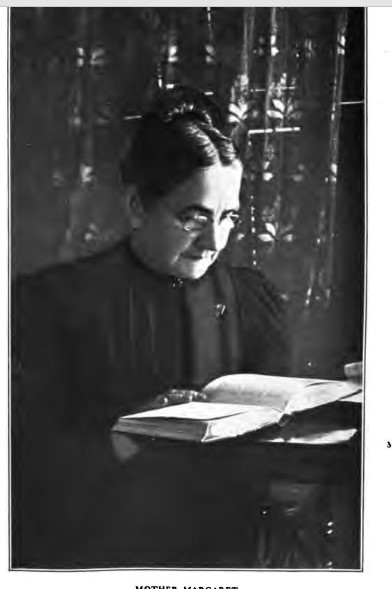
Dr. C. A. Greene as a character in Bee’s Flower Children 
Dr. Mary T. Greene as a character in Bee’s Flower Children, Unknown Castile girl. 
Orchard Cottage listed for sale in 1911.The Castilian 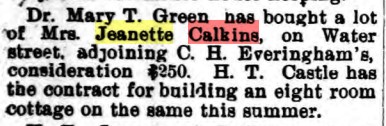
Purchase of Orchard Cottage Lot 1903, The Castilian 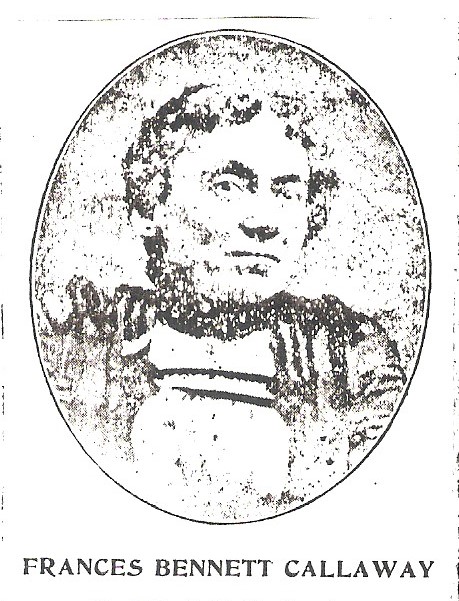
Frances Bennett Callaway, The Castilian, 1905 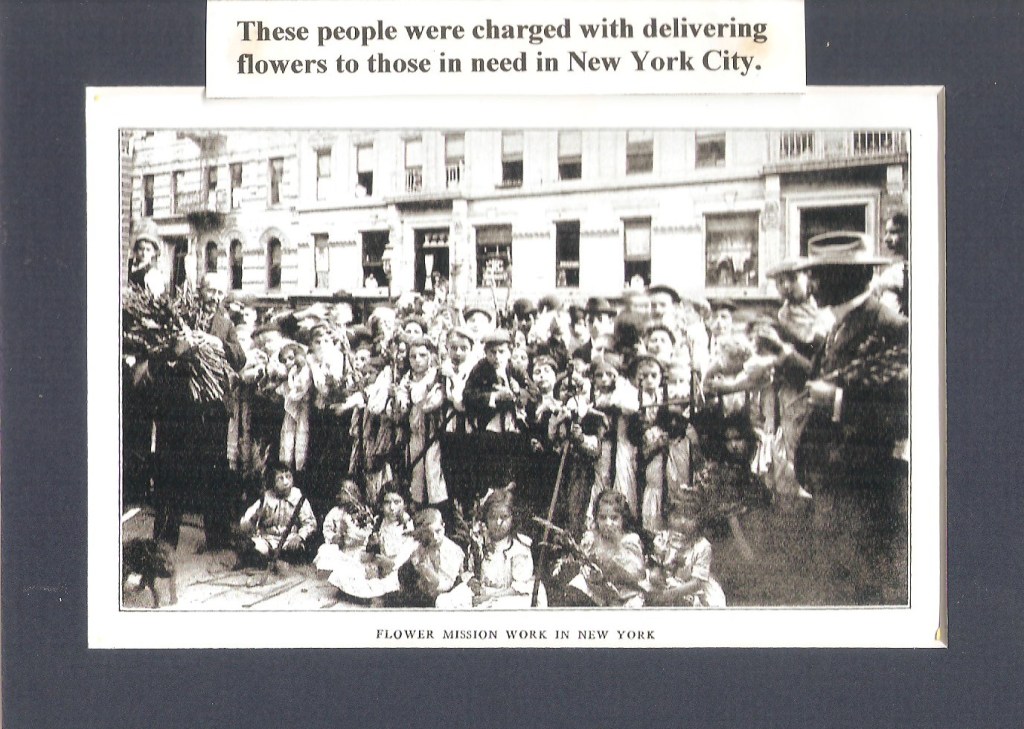
Flower Mission Children in New York City, Photo courtesy of Castile Historical House 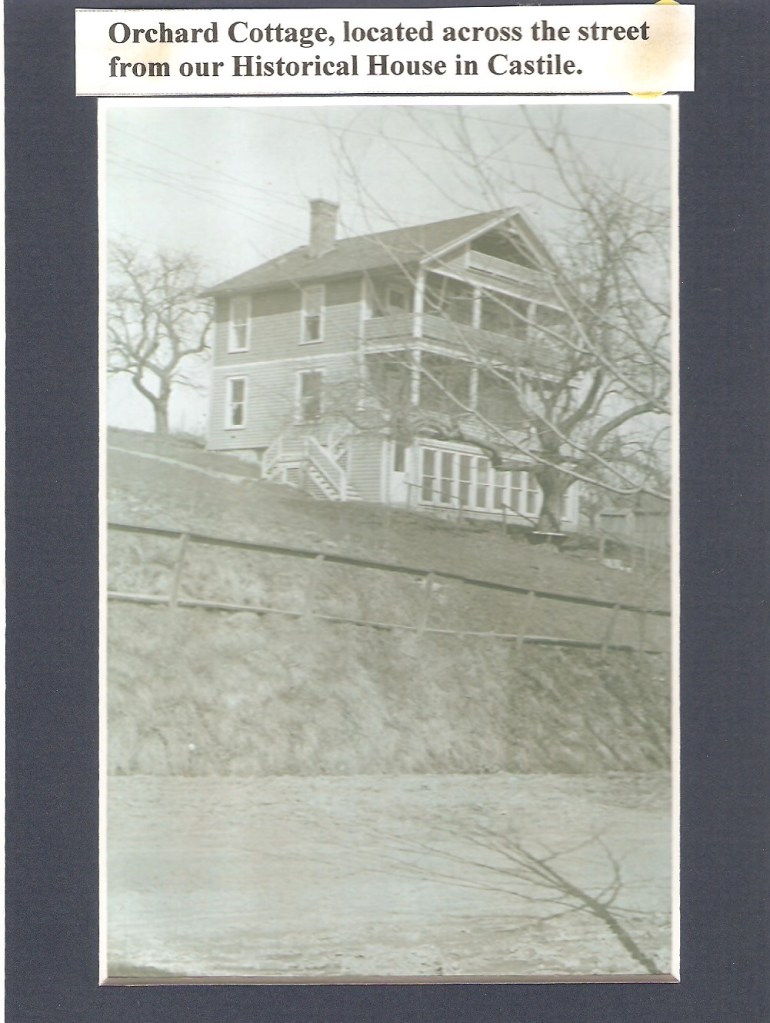
Orchard Cottage on Water Street (Park Road East) Photo courtesy of Castile Historical House 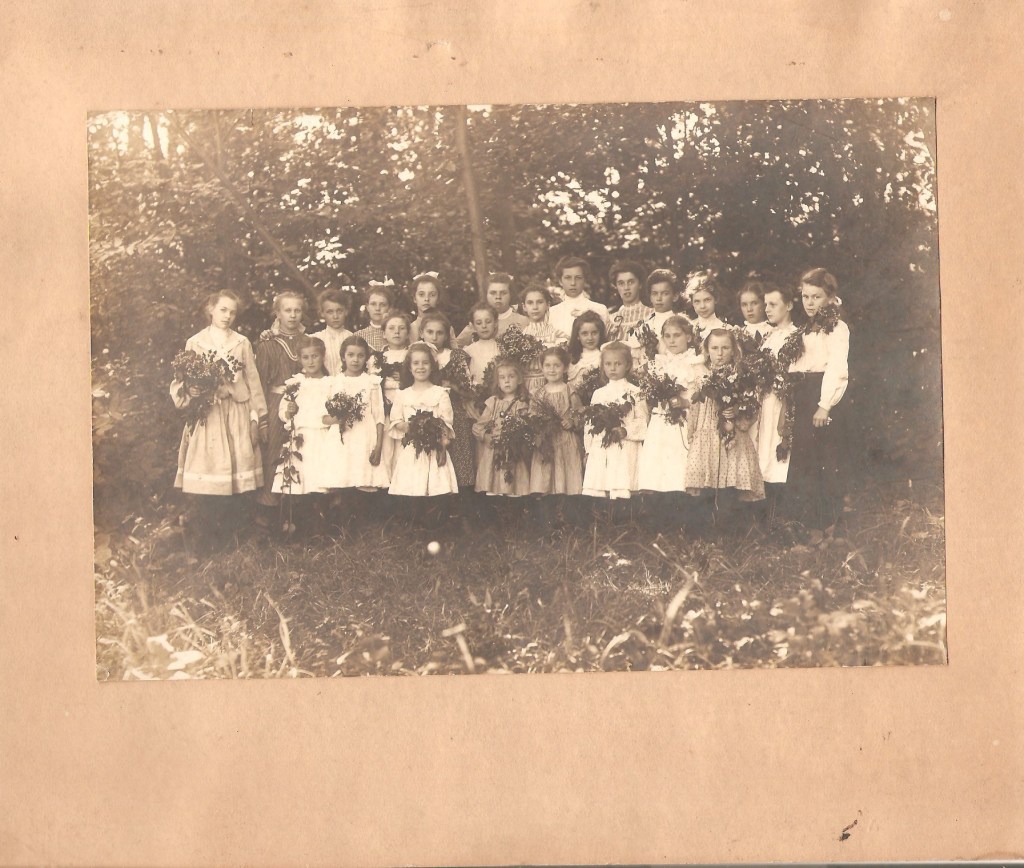
Flower Mission girls of Castile, Photo courtesy of Castile Historical House 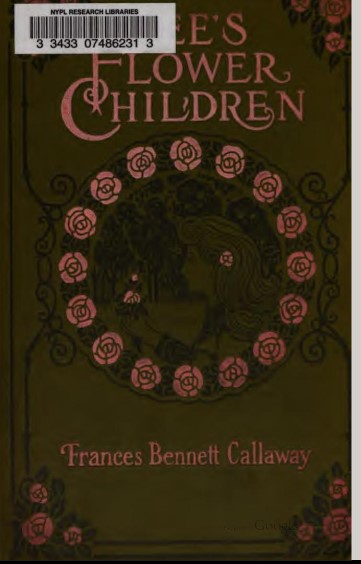
Bee’s Flower Children, Cover Courtesy NY Public Library 
Charm and Courtesy in Letter Writing
Resources:
Castile Historical House Records
The Castilian, March and May 1903
Federal Census Records, 1850, 1860, 1870, 1880, 1900
New York State Death Index
1880 Oberlin College Directory
New York State Census 1855
 Along the Genesee