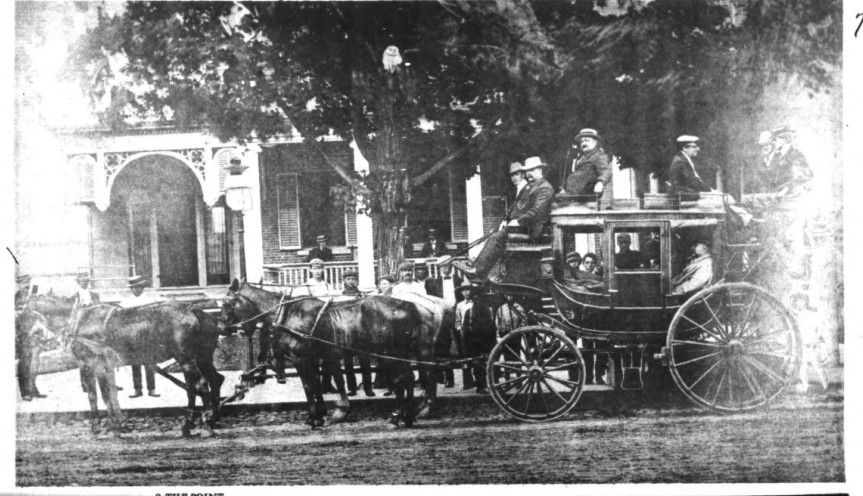
Just mentioning the word “stagecoach” likely conjures up images of vintage western movies featuring desperate gangs of robbers holding up passengers, or a high-speed chase across the desert with Indians or bandits in pursuit of a doomed stagecoach. That was certainly true in the western United States, but not for the Genesee Country. Stagecoaches were the first public transportation after villages began springing up in the region after 1810. Stagecoaches had been used in the state for some time, with a daily stage run between Albany and Schenectady as early as 1793.
The first reason for stagecoaches was delivering the U.S. mail throughout the Genesee Valley and areas west. These mailmen started out on horseback with generous saddlebags to hold letters, but as the population grew, the stagecoach was necessary to haul correspondence from Canandaigua to Geneseo, then to Warsaw, on to Sheldon, Orangeville, and finally to Buffalo. These postal carriers weren’t paid by the government to deliver the mail, but residents subscribed to this service if they wanted to receive their letters when the sound of the carrier’s tin horn announced his arrival in town.
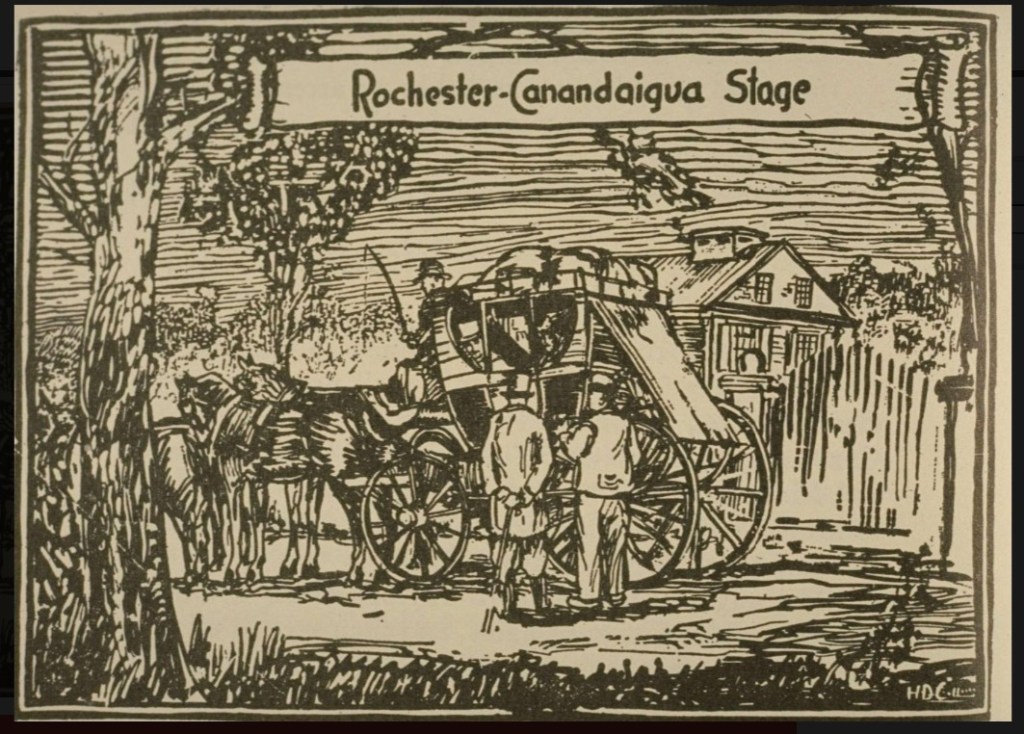
By 1823, a line of stages traveled the “improved” roads between Canandaigua and Warsaw by way of Moscow, which is present-day Leicester. The stage left Moscow on Saturday afternoon when the stagecoach from Canandaigua arrived, and passengers had a brief layover before boarding another stagecoach to Warsaw. The return trip from Warsaw began Monday evening to Moscow, then Tuesday evening to Canandaigua.
In Arch Merrill’s book, Stage Coach Towns, he writes about daily mail coaches between Owego and Rochester in 1830. The proprietor advertised that his coaches and horses were of superior quality and manned by careful drivers for “the accommodation of the public.” For the traveler who needed to get somewhere in a hurry, the stagecoach was his or her only option. However, speedy travel had quite another definition at that time. The trip between Owego and Rochester took two days, and for those traveling to the state capitol, five or more days one way wasn’t unusual.
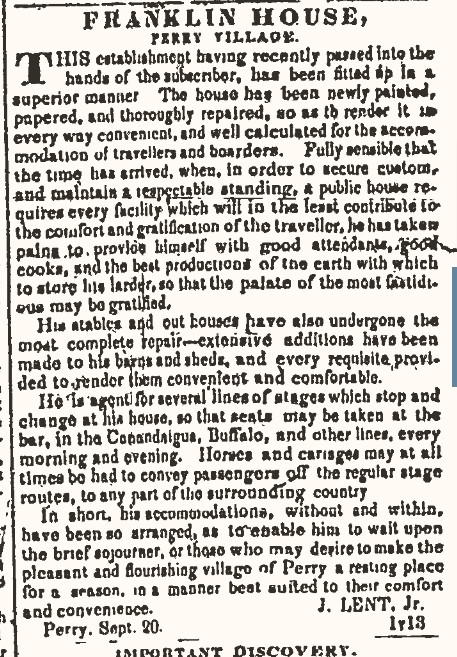
Stagecoach travel also initiated the growth of taverns and inns along the established routes that catered to tired and thirsty travelers. Many taverns had a distillery out in back that provided some rough whisky, plus beer and cider. You couldn’t expect a charcuterie board to go along with your drinks, but there was likely some salted meats of undetermined age, but no salads or fresh food. In the heyday of stagecoach travel, inns were about a mile apart along the routes to accommodate frequent changes of horses (every 10-15 miles was typical) and assist coaches that broke down. Some of these inns still exist today, but most are now private residences. One of the few still in business as an inn today is the Big Tree Inn in Geneseo.
Although many early stagecoaches were pulled by two horses, coaches were enlarged to carry more people, luggage, and mail, which required four horses. More routes were added, and daily stagecoach runs to popular destinations became the norm rather than once-a-week or bi-weekly runs. When the Genesee Valley Canal opened in 1840 from Rochester to Mt. Morris, stage lines quickly saw opportunities as connections for travelers who wanted to reach Rochester in a safer, more leisurely manner by taking them directly to a packet boat landing on the canal.
Riding in a stagecoach wasn’t a comfortable way to travel, with coaches filled inside and out with people packed together in a small space, worse than air travel today. It was the day of no deodorants and infrequent bathing, plus a lot of men smoking cigars and cigarettes. A newspaper ad in 1833 complained that stage line owners should have specific coaches for smokers or else prohibit smoking inside the conveyance. The ad ended with “Every such offender deserves to be put out with a fire-engine worked by the ladies. No nuisance in a stage coach is equal to this.”
Stagecoach travel was also dangerous—overloaded or unbalanced stages could tip over, throwing passengers and luggage everywhere. One such accident occurred in 1857 in a stage run between Wayland and Dansville. The freight on top unbalanced the stagecoach, which toppled passengers and freight to the ground. Six men, two women, a little girl, a baby, along with a poodle, found themselves underneath the stagecoach. They were able to crawl out of the wreckage, and fortunately, there were no serious injuries. Muddy roads could require travelers to get out and walk or even push the stagecoach out of ruts or up a particularly steep hill. Men might be called upon to help the driver with a broken axle or some other repair along the road, so the clothes that were clean at the beginning of the trip might be ruined by the time you reached your destination.
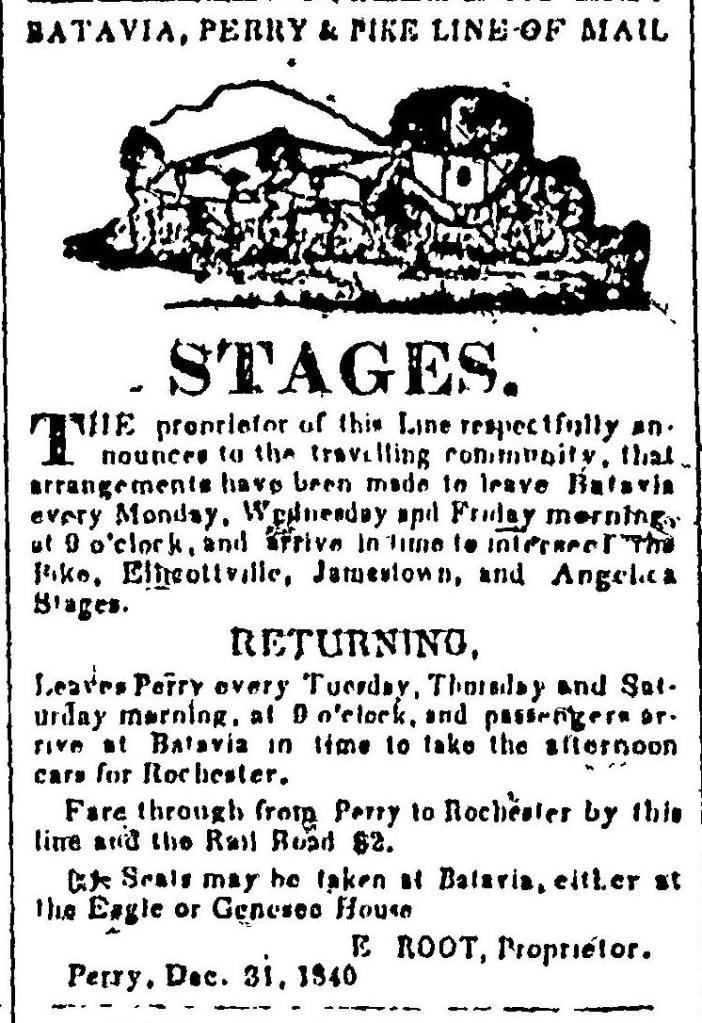
Stage lines warned passengers of these dangers, and one such stage line was owned by Edwin Root of Perry. Mr. Root was a man with a big personality, who owned a toy store and a livery stable besides the stage line. In Frank D. Robert’s History of the Town of Perry New York published in 1915, he writes, “Edwin Root…created more fun than all the clowns in the circus business could manufacture in a whole season. He was also known to be loudmouth driver, “who could guide four horses and hold his whip in one hand while with the other he could press his tin horn to his big mouth and blow blasts loud and long. The turn that he took in coming up to the hotel would have done credit to the Fifth Avenue nabobs with their English drags and outriders.” What a sight that must have been!
Root’s most popular route was between Perry and Geneseo, and he advertised heavily to keep his drivers busy. The ad went as follows:
“Male and Female Stages from Perry to Geneseo and back in a flash. Baggage, persons and eyesight at the risk of the owners and no questions asked. Having bought the valuable rights of young Master James Howard in this line, subscriber will streak it daily from Perry to Geneseo for the conveyance of Uncle Sam’s mail and family, leaving Perry before the crows wake up in the morning and arriving at the first house this side of Geneseo about the same time. Returning, leave Geneseo after the crows have gone to roost and reach Perry in time to join them. Passengers will please keep their mouths shut, for fear they will lose their teeth. Fare to suit passengers.”
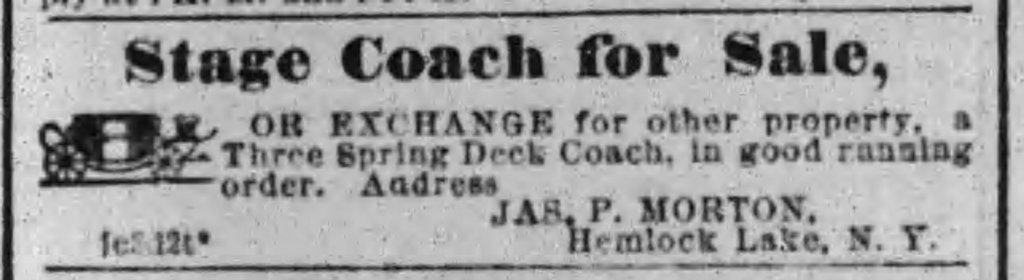
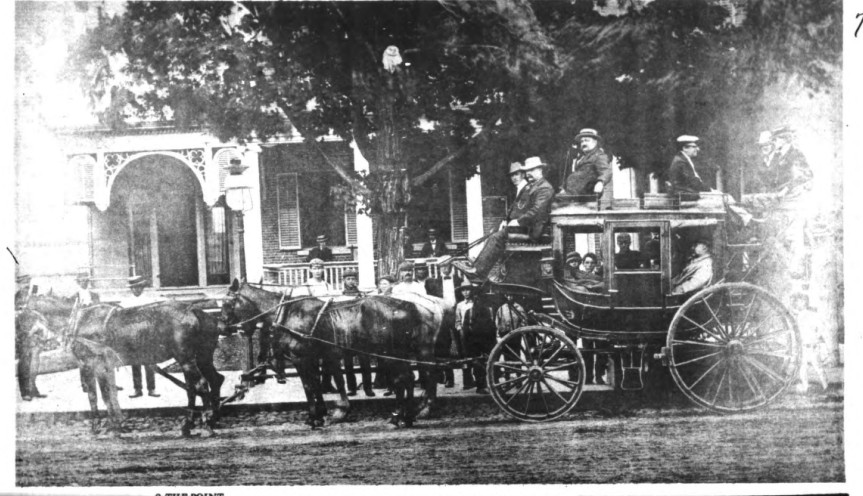
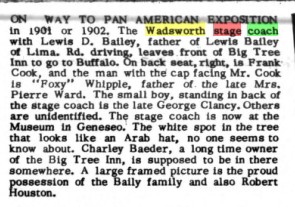
The 1840s were also the time when stagecoach lines knew their days were numbered. The railroads were coming into the Genesee Valley, and the iron horse was much faster than a team of four. Once the 1850s rolled around, the railroads were hauling freight and people all around the state. The first Portage Bridge that spanned the beautiful falls of the Genesee River was completed in 1852. The network of rails and destinations grew by the day, but the ever-nimble stagecoach line changed routes to take travelers to depots. They met passengers at those same depots and transported them to hotels, and also continued to deliver mail and passengers where the railroads didn’t go. By the 1880s most stagecoach runs were a thing of the past, and the coaches retired. Some hotels continued to use them for the convenience of their guests, and cities as public transportation. Some stagecoaches were purchased by individuals for their personal transportation, such as the Wadsworth family in Geneseo. They used it for a family wedding and also for transport to the Pan-American Exhibition in Buffalo in 1901. With the advent of the automobile, stagecoaches all but disappeared, and remain a romantic part of our past. A photo of that excursion is in the slideshow below.
Today, stagecoaches are usually found in museum exhibits, except in places like Tombstone, Arizona, where they offer leisurely tours of the “Town too Tough to Die,” which I’ve enjoyed multiple times. It’s not exactly comfortable, jammed in with as many people as will fit inside, so it gives one some idea of what travel in it was like. However, there isn’t a bone-jarring dash down the streets, which is a good thing, and the 20-minute tour makes it worth doing again. The romance of the stagecoach lives on.
Resources:
Stage Coach Towns, Arch Merrill
History of the Town of Perry New York, Frank D. Robert
Historical Wyoming, October 1957
Perry Democrat, 1841
American Citizen, Perry, NY, July 1838
The Times-Union, Rochester, NY, May 1833, 1857
Livingston County Leader, 1901
Crooked Lake Review, The Passing of the Stagecoach Era, 2003
 Along the Genesee