
As history bears out, one of the greatest motives for murder begins with an extra-marital affair. This was the case in the murder of Leman Bradley Withey of Avon, New York, in the winter of 1877.
FAMILY BACKGROUND
L. B. Withey was a native of Avon, born in 1840, and raised on his parents’ farm. The 1860 federal census shows the 20-year-old living at home with his parents, without regular work. But in 1862, he enlisted in the Union Army at Livonia on September 25, becoming a private in Company C of the 136th NYS Regiment. However, three days later, on September 28, he was declared Absent Without Leave (AWOL) at Portage, NY. He returned to Avon and married Rosetta Runyan, a local girl who was pregnant with his child. He rejoined the regiment on April 4, 1863, after President Lincoln’s proclamation in March 1863, giving amnesty to AWOL soldiers if they rejoined the army by April 1, 1863. Withey marched off to war in Pennsylvania, fighting in the most famous battle of that terrible war at Gettysburg in July 1863.
He was seriously wounded at Gettysburg by a gunshot wound to his face, which destroyed his left eye. While recovering in an army hospital in York, Pennsylvania, Withey went AWOL again on October 15, 1863, returning to Avon. By the 1865 New York State census, the couple had two children, William and Edward. He was finally discharged from the Union Army on May 27, 1865, for disability, which was likely the army issuing a discharge to complete its records at the end of the war.
Sometime after 1865, the family had its own place, and Withey worked as a farm laborer, according to the 1870 federal census. He also received a pension from the federal government because of the loss of his eye, which would have been $10-12 per month. Withey was known to be an alcoholic, and no doubt his family struggled financially because of it, and law enforcement was a regular visitor because of domestic violence. By 1876, four children were in the home, the youngest just a toddler. The oldest son, William, followed in his father’s footsteps, becoming addicted to alcohol, and the relationship with his father disintegrated as the two often argued over William’s drinking. On the night of December 26, 1876, William and L. B. got into a vicious argument when the 15-year-old and his younger brother, Edward, were both drinking and causing chaos in the home. The fight escalated with William grabbing a loaded firearm (some reports say a shotgun, and others say a revolver) and shooting his father in the eye. It seems more likely a shotgun was used due to William’s inebriation. The attack left L. B. totally blind and suffering from other injuries. William was charged and found guilty of the assault and sent to the Monroe County workhouse for 18 months.
JANUARY-FEBRUARY 1877
Rosetta tended to her now helpless, invalid husband throughout January, with doctors coming and going. The Witheys’ neighbor, William Pierson, was also a regular visitor to the home, helping Rosetta with L. B.’s care and chores around the house. Pierson seemed to have a lot of time to help out, although he was married with four children and his own farm to run. The small Avon community bubbled with rumors of an inappropriate relationship between Rosetta and Pierson. However, under the care of the two, Withey continued to recover, to the surprise of the doctors, and was able to go into the village with Pierson and Rosetta on Saturday, January 27, 1877. Withey was left at Smith & Hall’s store to sit and wait for his wife and Pierson to return while they shopped. Pierson went to Dr. William Nesbit’s store to purchase a half-ounce of arsenic because he had a rat problem. The white powder was bottled with the appropriate poison label, and Pierson rejoined Rosetta before picking up Withey to return home. After this outing, L.B. Withey took a turn for the worse. His symptoms were abdominal pain, vomiting, and a general decline in his health. Pierson took a special interest, sitting for hours by the man’s bedside and administering the medicine prescribed by the doctors. Rosetta, of course, took her turns to sit with her suffering husband and give him medication, but he only worsened. L. B. Withey died in the agony of convulsions on February 8, 1877, and his death was ruled as gastritis. He was quickly laid to rest in the East Avon Cemetery despite the suspicions of foul play from the community. In fact, Pierson made the funeral arrangements and attended to all the details for Rosetta.
MICHIGAN FLIGHT
It seemed that the Withey and Pierson families should resume a normal routine, but that wasn’t the case. On February 20, 1877, Rosetta Withey abandoned her three children, leaving them with different relatives before disappearing. She fled to Rochester, where William Pierson met her. He had also abandoned his family, selling property for quick cash. The pair then took a train to Canada, then Detroit, and finally to Jackson, Michigan, about 35 miles south of Lansing, where they first went to Rosetta’s sister Emma’s home. Emma told her sister to hurry up and marry Pierson since it was shameful to be traveling with a man who wasn’t her husband. Rosetta was reluctant, but the decision was made after Emma’s husband, John Maybee, spoke with Pierson about the same topic, not knowing the man was still married. Anxious to get rid of the couple, Maybee was relieved when they left. Pierson and Rosetta obtained a marriage license on February 26 and found a preacher. Pierson stood before the Baptist minister, swearing there was no impediment to the marriage. They began a new life in Michigan while the Avon community pondered the disappearances of the couple.
The previous rumors of an illicit affair and that, in all probability, Withey was helped to his grave circulated until law enforcement began to investigate after the funeral. After the exhumation of the body, an autopsy was performed, and it was determined that L. B. Withey had died from arsenic poisoning. Law enforcement and the district attorney’s office began gathering evidence to make a case against the pair. Surprisingly, William Pierson returned to Avon a few weeks later, leaving Rosetta in Michigan. His reason for returning was never discovered; however, this made locating one of the murder suspects much easier.
MURDER INDICTMENTS AND TRIALS
In May 1877, the Livingston County Grand Jury indicted both of them for the murder of L. B. Withey by poisoning. But it wasn’t until October 1877 that Rosetta was located and arrested for the murder. Both were committed to the Livingston County Jail as defense counsel was retained, and separate trials were set for the defendants.
William Pierson went on trial in February 1878, and after the week-long ordeal, the jury found him guilty of murder in the first degree. Pierson was sentenced to hang in April 1878. The sheer amount of circumstantial evidence from the neighbors concerning Pierson’s comings and goings from his home to the Witheys and the purchase of arsenic was well documented. Rosetta’s sister and her husband’s testimony about the fugitives and the forensic testimony of Professor Lattimore, who’d examined Withey’s stomach and intestines, made a strong case against Pierson. Professor Lattimore’s testimony revealed that he’d found a lethel dose of arsenic – a gram in the body, which, in the end, the defense was unable to overcome. His attorneys immediately filed an appeal, which stayed the execution.
Rosetta Withey’s trial was set for July 1878, but as she waited her turn, her eldest son William was again in the Livingston County Jail. In May 1878, William was released from the workhouse. Upon his return to Avon, he went directly to his paternal grandfather’s home and began savagely beating the elderly man with every intention of killing him. Constable Bishop, local law enforcement who was intimately familiar with the violent Witheys, was called, and in his attempt to arrest William, shot a bystander, then was stabbed by the boy in a tussle on the ground. Finally, the teenager was subdued and hauled away to jail. His parting words to the crowd were that he would kill his grandfather no matter where or how long he was sent away. No motive was ever determined. He was convicted of assault on November 21, 1878, and sent to the Elmira Reformatory. Both the constable and the bystander recovered from their wounds.
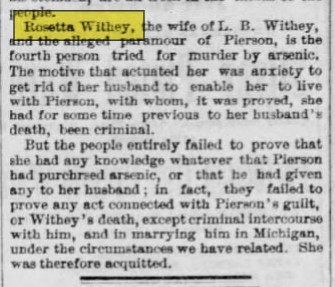
The atmosphere of Rosetta’s trial was entirely different than William Pierson’s. Her defense attorneys cleverly placed the youngest child, a very pretty little girl, next to her mother at the defense table throughout the proceedings. The mother and daughter’s affection was on display every day of the trial. Witnesses and evidence were all much the same, and especially damning was the desertion of her children. However, in the end, the jury was sympathetic to a mother, who the evil Pierson must have seduced into running away with him. It was a typical response of juries in the time period, who found it difficult to believe a woman, especially a mother, could be guilty of murder. The blame for poisoning L. B. Withey was placed squarely on Pierson, who was already convicted, and Rosetta Withey found herself a free woman.
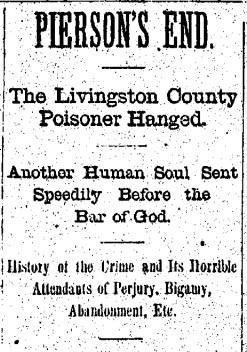
PIERSON’S END
William Pierson battled for his life until 1880 when his appeals were exhausted, and a last-ditch plea to the governor was turned down. The day preceding his execution was spent with his wife and 10-year-old son and a few close friends who’d lobbied for his release. To the last day of his life, Pierson proclaimed his innocence. On March 19, 1880, William Pierson was hanged in the yard of the Livingston County Sheriff’s residence. A board enclosure 18 x 24 feet had been constructed and roofed so a ghoulish public couldn’t see in. It was 18 feet high, and the gallows were built by John P. Best of Dansville, who had experience constructing gibbets.
ROSETTA’S SECOND ACT
As for Rosetta, her life took a bizarre turn or maybe a predictable one. She returned to Michigan sometime after her trial and her son, Edward, married in Jackson, Michigan, in 1885. Records show her applying for L. B. Withey’s Civil War pension in November 1888. She was still living in Michigan, and her last name was Stevens. Whether she had married a Stevens or changed her name is unknown, but probably she’d remarried. On July 29, 1895, she married Benjamin Rippleman in Battle Creek, Michigan, at age 55. Rippleman was a German immigrant with adult children, and her marriage to him was likely rocky. On April 9, 1896, Rippleman and his son Charles were arrested for assaulting Charles’ wife, Ida. The woman was reportedly so severely beaten doctors didn’t expect her to live. An additional report on the incident recounts that during his wife’s recovery, Charles came to visit her while awaiting trial and again assaulted his wife. She pulled out a gun hidden on her person, and shot him in the leg. Ida was diagnosed as being insane, however it sounds like a convenient diagnosis in a domestic abuse situation. The papers reported that the Rippleman family was a disgrace to the community, and now Rosetta found herself once again in violent family situation.
The Rippleman families left Michigan sometime after the incident and moved to Aberdeen, South Dakota and were still there in 1900. Although the disposition of the charges brought against the two men is unknown, it’s likely they were dropped because Ida was deemed insane. Charles was listed as divorced in the 1900 Federal Census and had his children with him. In 1902, Benjamin died—whether in South Dakota or Michigan is unknown. However, Rosetta immediately applied for his Civil War pension and did so in Michigan. According to the 1910 Federal Census, she was married to George Strouse, and the couple lived in Irving, Michigan. At the time the census was taken, they’d been married for one year. She was now 65 years old, and George was 45. Rosetta was George’s fourth wife—his marital history was quite unusual for the time. He went on to marry twice more after Rosetta’s death in 1916, and he died in 1926 at age 65. Both Rosetta and George are buried in the Irving Cemetery in the Strouse family plot.
Although William Pierson paid for his part in the murder of Leman Bradley Withey, Rosetta Withey walked away, exonerated by a sympathetic jury. Did she get away with murder? Was William Pierson talked into helping Rosetta rid herself of an abusive husband? Was it his idea? Rosetta took those answers to the grave.


 Along the Genesee