
After the departure of the Johnson family from Hornby Lodge somewhere between 1844 and 1845, the owner, Colonel George Williams, bought out the remaining lease from Elisha Johnson. Williams then leased it out as a public house, and the Lodge continued to be filled with people who enjoyed the spectacular views and eccentricities of the house. However, when funding was again in place to continue the canal work, the blasting underneath the house began to damage the structure. In the end, tunnel construction was halted due to the instability of the rock and several fatalities, and the magnificent Hornby Lodge was dismantled for safety reasons in 1849. The last tenant, Festus H. Moore, who ran Hornby Lodge as an inn, brought suit for $5,300 in 1851 against Williams, claiming loss of business when the house was torn down. Unfortunately for Moore, he was unsuccessful. Today, no remains of the grand log cabin are to be seen. However, the park museum has a sofa from Hornby Lodge on display along with Mary Abigail Johnson’s wedding announcement.
While Hornby Lodge disappeared, along with the doomed canal tunnel, which was filled in, Elisha Johnson had a new opportunity and traveled south to Tennessee. His son, Mortimer, had urged his father to come and help him revive a foundry in Tellico Plains. Elisha’s brother, Ebenezer, the first mayor of Buffalo, New York, also joined the family enterprise.
How Mortimer came to be in Tellico Plains is a mystery, although he had been in the South for several years before 1850. The 1840 federal census lists Mortimer, his wife, and a daughter under the age of five as residents of St. Augustine, Florida (before Florida was a state). In the 1850 census, the family is in Tellico Plains. There were now three children, with their four-year-old son, Tellico, listed as being born in Tennessee. So, it’s safe to assume they had been in the state at least since 1846 and likely earlier. Another Johnson family mystery is an obscure story about Mortimer killing a man in a duel in New York and fleeing south to avoid prosecution. (New York State outlawed dueling in 1839 and was the first state to do so.) To make matters more complicated, if this story is true, the man killed in the duel was Mortimer’s brother-in-law, Elihu Mumford. The only clue is that Mortimer’s son, Hugh, who was nine in 1850, was born in New York State (1841), and Mortimer’s brother-in-law, Elihu Mumford, died rather suddenly in New York City on March 17, 1844. The funeral notice for Elihu was a bit odd, only saying he died suddenly and that his brothers and friends were invited to the service. However, there are no details regarding the cause of death, and there is no verification of a duel or if Mortimer was involved.
We do know that after her husband’s death, Mary Johnson Mumford moved back to Rochester, where she immediately had her two children baptized in the Episcopal Church, where the Johnson family were members. She then moved to Tellico with her parents and never remarried.
While the secrets of the Johnson family may never be fully revealed, the Johnson brothers and Mortimer built a booming ironworks business named Tellico Iron and Manufacturing Company. Tellico Plains, approximately 70 miles south of Knoxville, was originally Cherokee land and today is near the Cherokee National Forest. Elisha and his brother, Ebenezer, invested capital of $100,000, which was needed to enlarge the furnace, improve the foundry, and purchase 30,000 acres of timberland and ore. The company produced many useful household items, such as kettles and tools. The Johnson family also built a distillery that produced corn whisky, a business not uncommon at this time in the South.
In 1846, Elisha began the construction of a new home for his family near a spring that connected to the Tellico River. The mansion was nothing like Hornby Lodge, but it fit its surroundings. It was a large house to accommodate Mortimer’s and Mary’s families as well as Elizabeth and Elisha. One of the interesting features of the house was its large windows on the ground floor that boasted 56 to 72 panes of glass. These windows could also be used as doors, making escape easy. There were also three fire escapes from the second floor, a safety feature that was unusual for the time. These were double wooden ladders, and not surprisingly, there was a rumor that a secret tunnel underneath the house ran to the spring as another means of escape, but it was never found after the time of the Johnsons.
The Johnsons became well established in Tellico society, entertaining and serving in various public offices. Mortimer was appointed as a postmaster twice while he lived there and was also involved in local politics later on. However, Mortimer and his family left Tennessee and moved to Buffalo around 1852, according to the New York State 1855 Census. After his wife’s death in 1860, he returned to Tellico the same year. His uncle, Ebenezer, died at Tellico Plains in 1849 from dropsy, which we know as edema today. Elisha, Elizabeth, Mary, and her children lived comfortably at the mansion until Elizabeth’s death in 1860. The rapidly evolving politics of southern states seceding from the Union and Lincoln winning the presidency spiraled into the Civil War, which began in 1861 and changed the course of the family’s fortunes.
Elisha found himself in a political pickle with both the Confederacy and then the Union, although records indicate the ironworks hadn’t been active since 1856. The Confederacy quickly commandeered the foundry in 1861, and its products changed from kettles to cannonballs and ammunition. Another blast furnace was added, and it’s reported that 20,000 metric tons of iron ore was mined before 1863 to supply munitions to the Confederate Army. In 1863, the Union Army converged on the state of Tennessee, and General George T. Sherman, who was in Knoxville, received reports about the ironworks and rode into Tellico Plains on December 10, 1863. The visit wasn’t a social call, and Union troops destroyed the ironworks under Sherman’s orders. Elisha and Mortimer then pleaded with General Sherman to spare them from execution as traitors and also spare the family’s home since their sympathies truly lay with the Union. Father and son told the Union officers they had been forced to cooperate with the Confederates. In fact, Colonel H. B. Latrobe of the Confederate Army supervised the work to ensure there was no sabotage or slacking to hinder production. General Sherman relented, satisfied that the foundry was beyond repair and the men were truthful. After this dangerous incident and the business’s financial ruin, Elisha decided to go to Ithaca, New York, to live with his daughter, Emily Johnson Grant. His daughter, Mary, and her children, Elihu and Mary, also left the mansion in 1864 but continued living in the area, as did Mortimer. The Tellico Mansion remained vacant until the 1870s when it was purchased by Colonel W. A. Hoskins of Chattanooga, who tried unsuccessfully to revive the ironworks.
Elisha’s final years were spent quietly in Ithaca, and he died there on June 24, 1866, at age 81. His will, however, was made in Tennessee, and as he still owned property there, it was probated in Monroe County, Tennessee. His daughter, Mary, was the named executrix, and just as she had begun winding up her father’s affairs, she died shortly after her appointment in 1866. The following year, her son, Elihu, was appointed administrator. (It’s interesting to note that Mortimer wasn’t the executor or the administrator.) However, the estate was insolvent and a messy affair to resolve with many creditors and litigation, likely a giant headache for Elisha’s grandson.
The ambitions of Elisha Johnson were realized in many ways—a pioneer of Western New York, mapmaker, surveyor, politician, builder of waterways, railroads, fabulous houses, and finally, an infamous ironworks. His failures were just as spectacular and quite public: the doomed canal tunnel, the loss of Hornby Lodge, and the destruction of the Tellico Ironworks. He was a man who took risks, enjoyed many successes, gave generously to the communities he lived in, and left an indelible mark on the history of the Genesee.

Ebenezer Johnson, Wikipedia 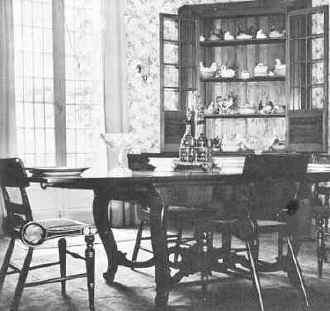
Dining Room with escape windows, telliquah.com 
Elisha Johnson at age 80, Ancestry.com 
Tellico Mansion, telliquah.com 
Wedding Announcement, Ancestry.com 
Mary A. Johnson Mumford, Ancestry.com 
Mortimer F. Johnson, Ancestry.com 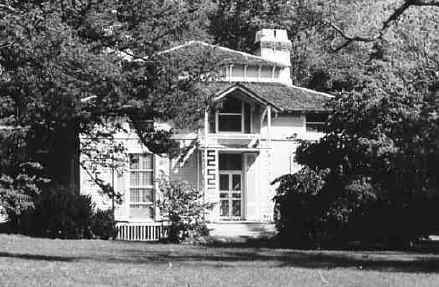
Tellico Mansion, restored, telliquah.com 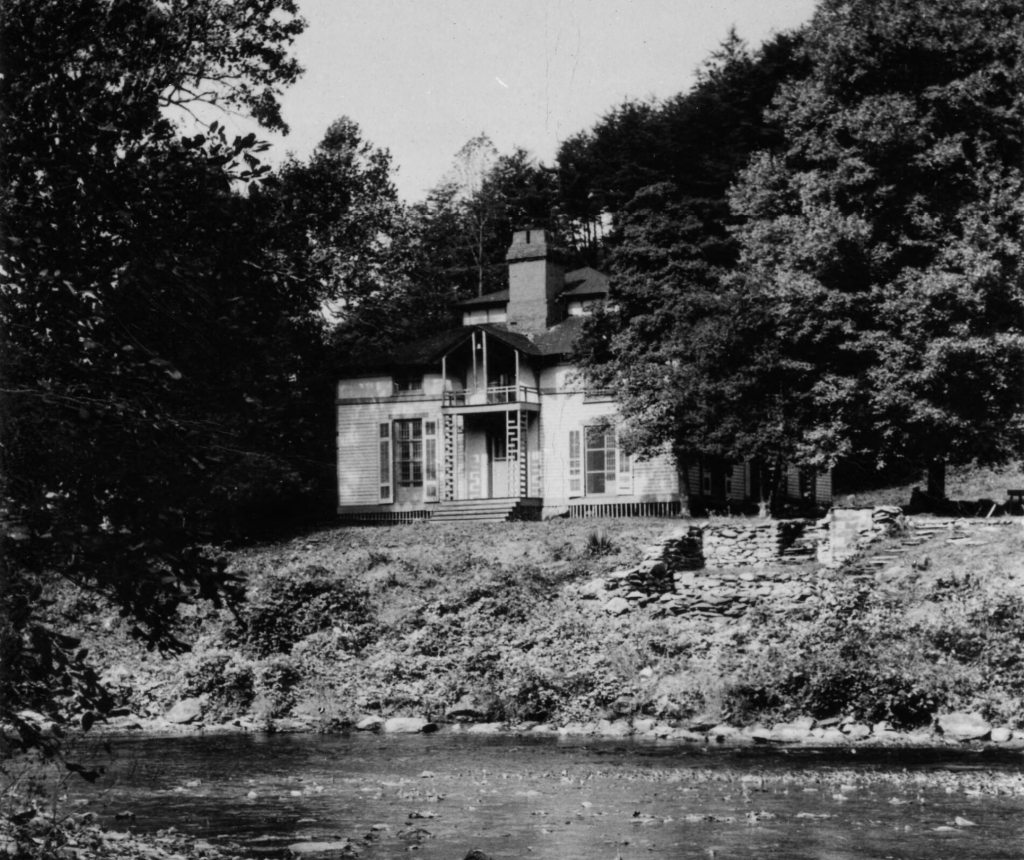
Tellico Mansion, restored, telliquah.com 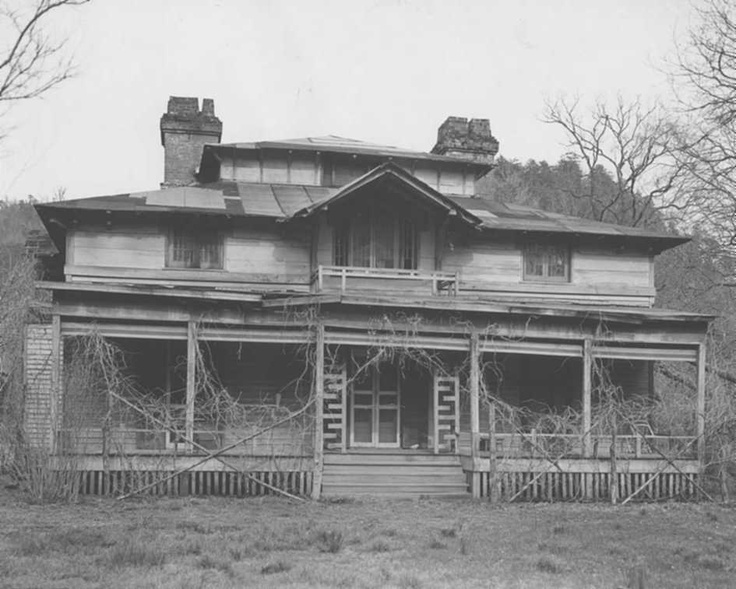
Tellico Mansion abandoned, Ancestry.com
 Along the Genesee