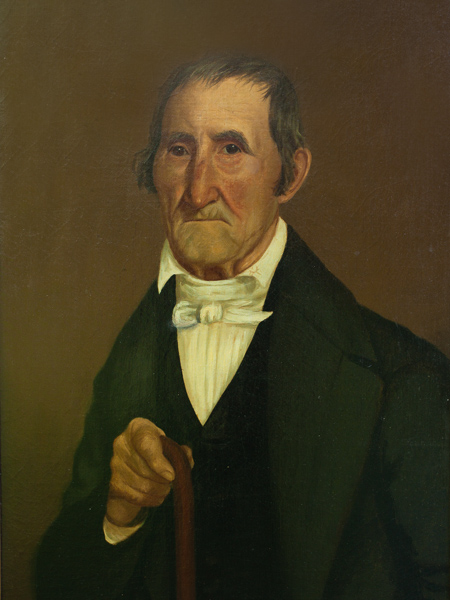
Before Major Van Campen’s discharge from the army, he had one more significant encounter as an American soldier. In late summer of 1783, as he scouted the woodland trails in the Wilkes Barre area, he spotted a man in British uniform riding horseback. Of course, he stopped the man, ready to take him prisoner. He soon learned that the stranger was Ebenezer Allan, a/k/a Indian Allan, a notorious loyalist known for his cruelty and brutality. He was hated by American soldiers who’d seen the slaughter of defenseless women, children, and elderly in the Genesee Country done by his hand. However, Allan had been tossed out of the British army. He was now carrying a letter to the U.S. Congress in Philadelphia to broker peace with the Six Nations, which still raided American settlements in New York and Pennsylvania. After confirming the traitor’s mission, Van Campen helped escort him quietly out of the area before his identity was known. (For more about Ebenezer Allan and his story, click here.)
After Moses was discharged from his military duties, he focused on his personal life, which had been long neglected, and married Margaret McClure, daughter of James McClure, on December 10, 1783. He took over the McClure farm, which he’d stockaded in 1781, and the couple settled into domestic life. He and the family prospered there, and three daughters were born to them within the next six years. Mary was born in October 1784, Anna in October 1786, and Priscilla in September 1789. Always ambitious, Moses began looking for a property of his own, finding a large parcel of land to his liking near Briar Creek, which wasn’t far from the McClure farm near Wilkes Barre. Two more daughters were born to the couple after their move to the new property—Elizabeth in April 1792 and Lavinia born in March 1794. Not only did Moses farm the land, but he also established himself as a competent surveyor in the area. The family stayed at Briar Creek for about five years until reports of the availability of fertile land in Allegany County, New York, near the Genesee River Valley, made its way to Briar Creek. Even with five young daughters, Moses, ever the adventurer, convinced Margaret of a better life in Allegany County, New York. In the summer of 1796, the family packed their household goods, personal belongings, food, and livestock to make a challenging water trip to the McHenry Valley, now Almond, New York. Flat-bottomed boats were used for transportation, and while the men in their group poled the boats northward, Margaret had to keep track of her daughters, ages eleven to two years old, on their precarious vessel, plus manage the daily tasks of cooking, washing, and camping with young children along the riverbanks. Once in New York, they floated up the Chemung and Canisteo Rivers, stopping in the village of Canisteo.
While they were in Canisteo, the settlers met a large group of Senecas who were also staying near the village. Moses Van Campen’s name was well known to them, and it was soon learned that John Mohawk, Van Campen’s old enemy, was present. The situation became tense as neither side knew how the men would react to seeing one another again. The last time had been in a furious hand-to-hand battle with Moses inflicting a deep shoulder wound on the Seneca with a tomahawk. The travelers, villagers, and Senecas gathered to watch the two men moving toward one another. They were allowed to speak privately, and the men agreed that the time of hostility and war was past. To everyone’s relief, they shook hands, and Canisteo enjoyed a celebratory feast that evening.
When the three families finally reached McHenry Valley, the men began constructing simple log homes to shelter their families. Blankets were hung over the doorways, and oiled paper was tacked up over the window openings at first. When fall arrived, with the hint of cold weather, the men worked together to construct the chimneys needed in the houses and killed 36 deer all in one week in preparation for winter. As soon as additional settlers arrived in the same area, they learned that Moses was a surveyor, and his services were in high demand. Colonel Williamson, the agent for the Pulteney Estate (Phelps & Gorham Tract), hired him to subdivide parcels of land, and Philip Church, a young man of 23, approached him. Church had purchased 100,000 acres in Allegany and Genesee Counties through a foreclosure sale and needed to subdivide the massive tract to sell to eager settlers coming into the area. Church also founded the Village of Angelica (named after his mother) and planned to settle there.
The offer from Philip Church was one Major Van Campen couldn’t turn down, and with three other surveyors, began the considerable task of walking the property to map it. Church accompanied the men and found himself in the company of an expert frontiersman as he followed the major through the rough terrain. After camping in the wilds for weeks, much work on mapping the tract was done, and Philip Church thought it would be the time to trek north to see the magnificent Niagara Falls. This was no day hike, but Moses was game since the last time he’d been there was as a POW of the British. Moses led the way, being familiar with the Indian trails that led to Ft. Niagara. The two were ill-prepared for the journey, but they managed to get meals from Seneca villages on the way until the last leg of the hike. By this time, their clothes were in tatters, their shoes were barely usable, and they hadn’t eaten in two days. Stumbling into New Amsterdam (Buffalo), they could finally resupply and enjoy the beauty of the Falls. Instead of returning home, Church decided to visit the Wadsworths in Geneseo before going to Bath, New York. However, they ran out of supplies and money on their way to Geneseo using the White Man’s Trail (a road built by the Holland Land Company). Fortunately, they came upon a militia group training along the Genesee River. Taking pity on their straightened circumstances, Richard W. Stoddard, a militia officer, gave Church money to see them on their way. We can be certain the Wadworths welcomed Church, a family friend, and his companion, the famous Major Van Campen.
After his return home to McHenry Valley, the Van Campens would move again to be nearer the work in Angelica. Moses chose a 47-acre parcel near the village, building a new two ½-story brick home with local materials. The house was completed in 1809 and is now on the National Register of Historic Places. Besides overseeing the building of the family residence, Moses continued his surveying work for Church and others, plus served on the Highway Commission beginning in 1806 and serving various terms until 1830. He was Highway Overseer in 1807, 1812, and 1814. He designed the road from Canandaigua to the Olean River in 1810, the road from Angelica to the village of Olean in 1810, and the turnpike from Bath to Olean. As if that wasn’t enough, he was a founder of the Angelica Masonic Lodge in 1808 and was commissioned to build the county jail and courthouse on the village square. In 1812, the Van Campens and several other Angelica residents formed the Presbyterian Church. Moses was ordained as a ruling elder that same year and served in that capacity until 1831.
He served as county treasurer from 1814-1826; he was a justice of the peace, a constable, assessor, election inspector, and held several other offices throughout his long life. His impact on the early organization of Allegany County was seen in every facet of county government.
In March 1816, likely while visiting daughter Elizabeth in Dansville, Margaret fell ill and died. Moses took his beloved wife back to Angelica, and she was buried in Until the Day Dawn Cemetery. Moses never remarried and continued work as a public servant until 1831, when he moved to 13 Ossian Street, Dansville.
During the intervening years, he renewed an old friendship with the Seneca captive and translator, Horatio Jones. Jones had saved his life when he was captured the second time during the war by the Senecas, convincing them to take the young officer to the British at Fort Niagara. Jones, who had survived many years as a Seneca captive, was finally freed after the war and had been given land along the Genesee River near Leicester by his captors, possibly for his help with the Treaty of Big Tree in 1797. The men got together at least once a year to regale one another about their adventures, no doubt embellished as time went on. Once Moses was living in Dansville, visits were more frequent to Jones’ Sweet Briar farm, which encompassed 3,000 acres of river bottom land. The men spent many happy hours together discussing politics, farming, the war, their part in it, and their families. Those times were cut short in 1836 when Jones passed away at age 73.
In 1841, the major was asked to participate in the re-interment of Boyd and Parker, who’d been savagely tortured and killed by Chief Little Beard’s men during Sullivan’s Campaign. A community group had organized to remove the bodies from Leicester and re-inter them at Mt. Hope Cemetery in Rochester with an appropriate memorial. Although he was 84 and in failing health, he agreed to speak at a ceremony held for the men in Dansville, stating he couldn’t travel to Rochester. He had been their comrade in arms and did his duty in honor of their sacrifice.
Moses’ grandson, J. Niles Hubbard, published his grandfather’s biography the following year, finally putting in print the famous stories of his days as a ranger for the Continental Army in Pennsylvania and his daring exploits as a soldier, prisoner of war, and pioneer of Allegany County. In 1845, Moses suffered a stroke and, over the next four years, was cared for by his daughters and a grandson. He moved back to Angelica in June 1849 to live at the homestead with his daughter Anna Van Campen Burr and her family. The old soldier, surveyor, family man, and public servant departed this world on October 15, 1849, at age 92—a man full of years with an unblemished reputation. His pastor, Rev. Thomas Aiken, wrote in Major Van Campen’s obituary, “His Christianity was pure, his views of religion sound and scriptural, and his fidelity and integrity of character were like his well-aimed rifle true to the mark.”

Van Campen House, circa 1893 Courtesy of mosesvancampen.com 
Gravestone for Moses Van Campen Courtesy of mosesvancampen.com 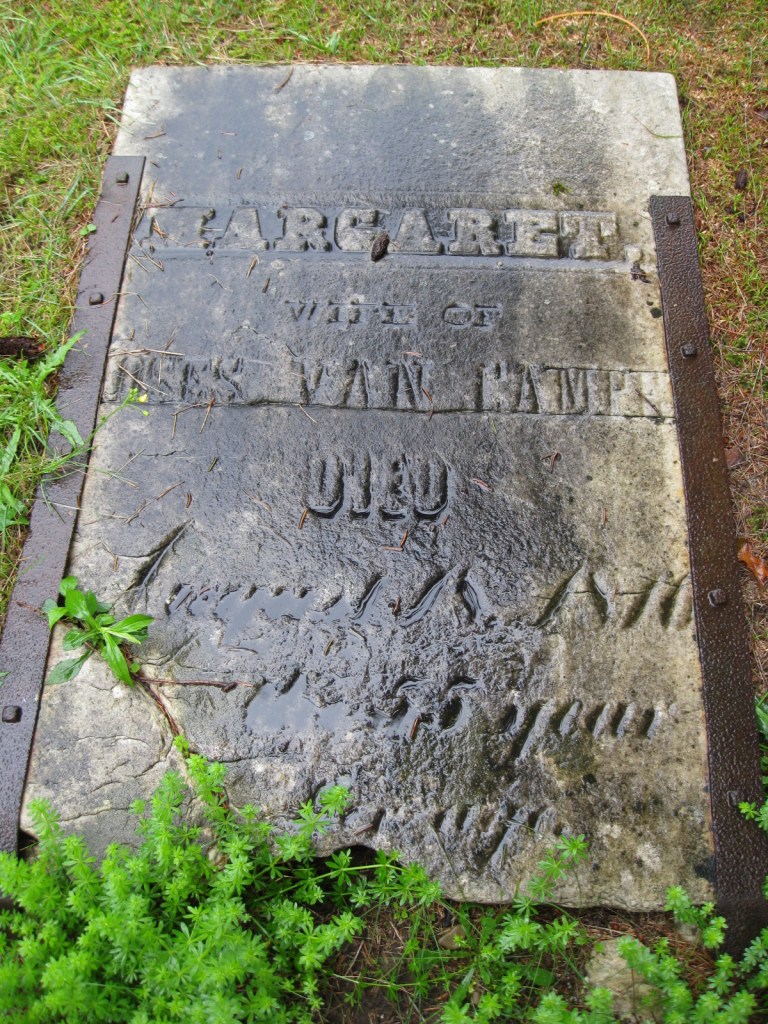
Margaret Van Campen gravestone Courtesy of mosesvancampen.com 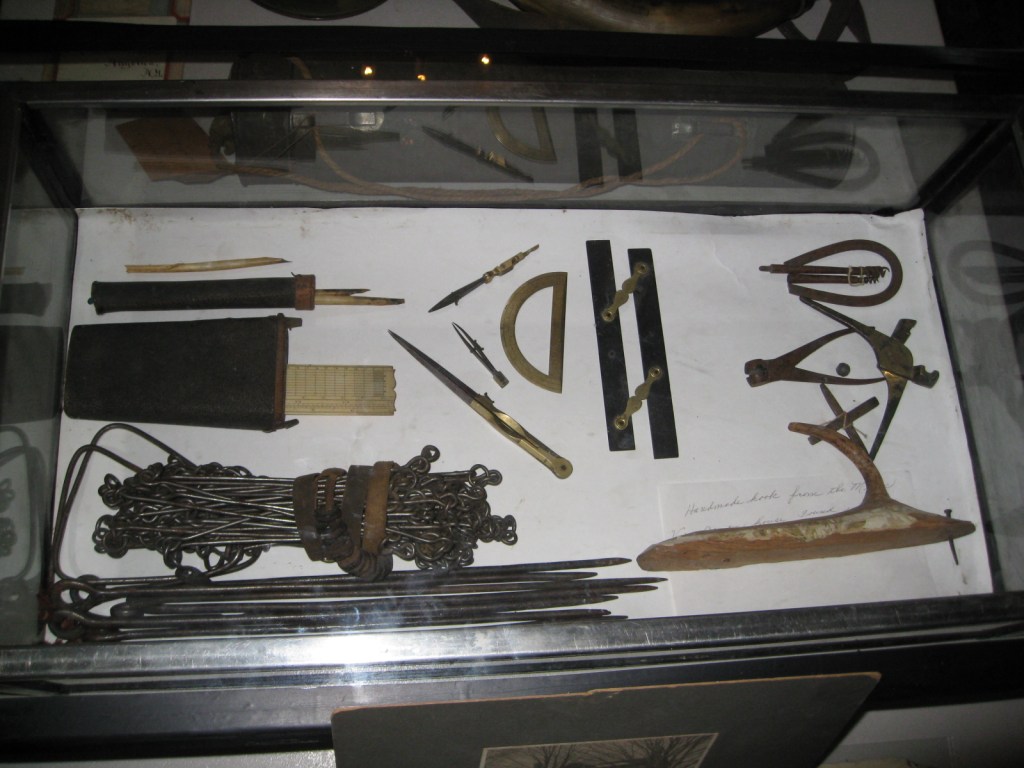
Moses Van Campen’s surveyor’s tools in Angelica Museum Courtesy of mosesvancampen.com 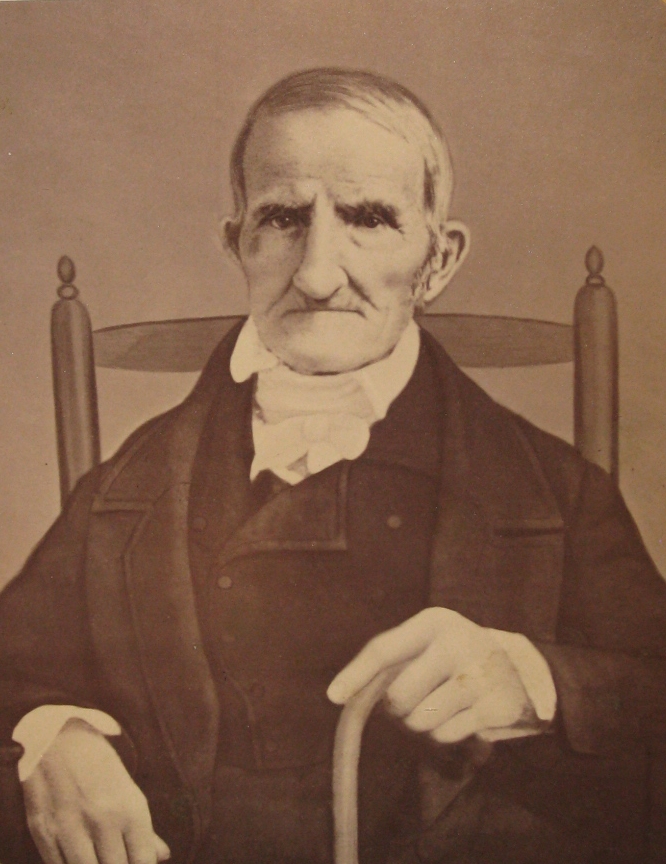
Moses Van Campen at 90 years old Courtesy of mosesvancampen.com
Resources
Mosesvancampen.com
Sketches of Border Adventures in the Life and Times of Major Moses VanCampen, J. Niles Hubbard
Letchworthparkhistory.com – Horatio Jones
The Capture and Escape of Jonah Rogers, Moses VanCampen, Peter Pence and Abram Pike, George Peck, D.D.
Revolutionary War Petition and Affidavit for Pension 1838
Wikipedia.com – Van Campen House
A Narrative of the Capture of Certain Americans at Westmoreland, Moses VanCampen
 Along the Genesee